

4.0
Excellent
Very good
Average
Poor
Terrible
Pros
- Genuine women-first positioning
- strong AI-driven safety tools
- active feature development
Cons
- Frequent unexplained account bans
- high top-tier pricing
- shrinking paying user base
Table of Contents
Bumble Review (2026): Features, Pricing, Pros, Cons & Is It Worth It?
Independent editorial review. BestFreeDatingApp.com is not affiliated with, sponsored by, or endorsed by Bumble or Bumble Inc. Bumble® is a registered trademark of Bumble Holding Limited.
Introduction
Bumble launched in 2014 with a premise that stood out immediately in a category Tinder had just created: in matches between a woman and a man, the woman has to send the first message, or the match disappears after 24 hours. Founder Whitney Wolfe Herd, who had co-founded Tinder two years earlier, built Bumble around that single rule, and it’s still the app’s defining feature more than a decade later — even as the company has since softened it with optional features that let men send a prompt-based “opening move” first.
Bumble is owned by Bumble Inc. (NASDAQ: BMBL), which also owns Badoo and, until recently, ran Bumble For Friends as part of the same app before spinning it out as a standalone BFF app. The company went public in February 2021, briefly making Wolfe Herd the youngest self-made female billionaire — a milestone that didn’t last, as Bumble’s stock has since fallen more than 90% from its IPO price. Wolfe Herd stepped down as CEO in 2024, was succeeded by former Slack CEO Lidiane Jones, and returned to the role herself in March 2025.
The app is available in roughly 150 countries. Its user base has historically skewed toward women wanting more control over who contacts them, though—as with every major dating app—actual usage spans casual dating, serious relationships, and everything in between.
This review draws on Bumble’s official support documentation, its 2026 investor disclosures, its official product announcements, and a cross-section of user feedback from the App Store, Google Play, Trustpilot, and ConsumerAffairs.
Editor Rating
3.9/ 5
Excellent
-
Active Users
100M+
-
Best For
Women-first messaging, singles who want more control over unwanted contact
-
Platforms
iOS, Android, Web
-
Price
Free+Prenium
About Bumble Inc.
Bumble Inc. was co-founded by Whitney Wolfe Herd and Andrey Andreev. The two previously founded dating app Badoo in 2004. Andreev sold his stakes in both companies to private equity firm Blackstone in November 2019, ahead of Bumble’s IPO in 2021. Today, Bumble Inc. is one segment, which includes both Bumble and Badoo apps, with Bumble taking a larger share of revenue and users.
A look at the company’s recent public filings shows a company in the midst of a deliberate shrink-to-grow strategy. Wolfe Herd has spoken of 2025-2026 being a period of “resetting” the member base, rather than pursuing raw user growth, by purging low quality and inactive accounts, before re-launching a rebuilt, AI-enabled version of the app later in 2026. This trade-off is evident in first quarter 2026 results: revenue and paying users fell, but profit margins improved sharply.
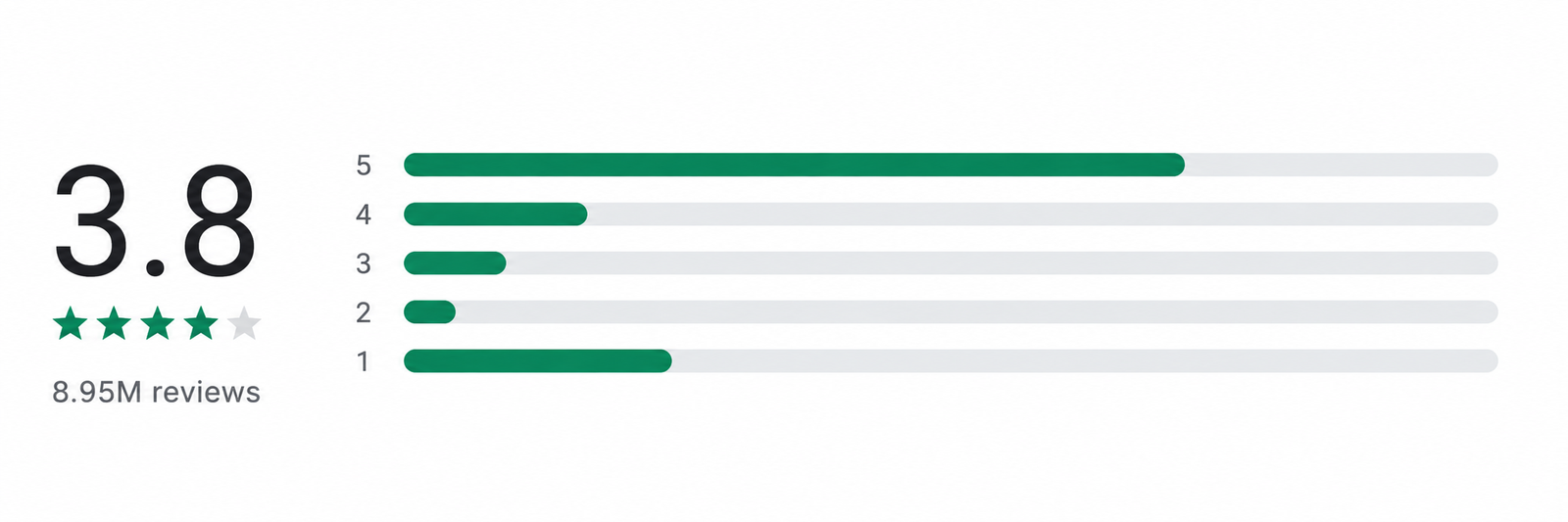
Google Ratings vs App Store Ratings
The dating app bringing people closer to love
Bumble is the dating app where people meet, make connections, and start their love stories. We believe meaningful relationships are the foundation of a happy, healthy life — and we’re here to help you find yours with a commitment to member safety and tools that empower confident dating.
Match with the right people, date, and find meaningful connections.
Bumble is a free app for meeting singles and building connections grounded in mutual respect and trust. Whether you’re ready to find the one or date for fun, Bumble can help you connect with real people to build something authentic.
As champions of love, we prioritise creating a space where our members feel respected, confident, and empowered to make connections.
💛 Our members are at the heart of everything we do.
💛 We put safety first — so you can date with confidence, knowing you’re connecting with verified matches.
💛 Respect, courage, and joy guide how we show up — and inspire others to do the same.
Try our free features — built to make dating easier.
– For better connections, conversations, and dates, personalise your profile with interests and prompts to showcase who you are, what you’re into, and what you’re looking for.
– Trust that the person you’re talking to is real with ID verification.
– Feel confident with expert-backed dating advice designed to help you succeed
– See what music you bond over by linking your Spotify account.
– Video chat and share your favourite pictures with your matches to get to know them better.
– Chat with peace of mind — knowing that when you’re talking to new people, all messages must meet our community guidelines
– Get extra reassurance by sharing the details of your meetups with someone you trust.
– If you’re ever in need of a dating break, hide your profile with the Snooze Mode (you’ll still keep all your matches).
Want even more ways to connect? Bumble Premium unlocks extra features to boost your dating experience.
💛 See everyone who likes you.
🔍 Use advanced filters like “What are they looking for?” to meet people who share your values, hobbies, and goals
🔁 Rematch with expired connections — so you don’t miss out on a great potential date.
😶🌫️ Browse anonymously with Incognito Mode and only be seen by who you want to see you.
➕ Extend your matches by 24 hours.
👉 Swipe as much as you like to meet more people.
✈️ Tap into dating scenes around the world with Travel Mode.
✨ Stand out and get noticed with free SuperSwipes & Spotlights, refreshed weekly.
How Bumble Works
-
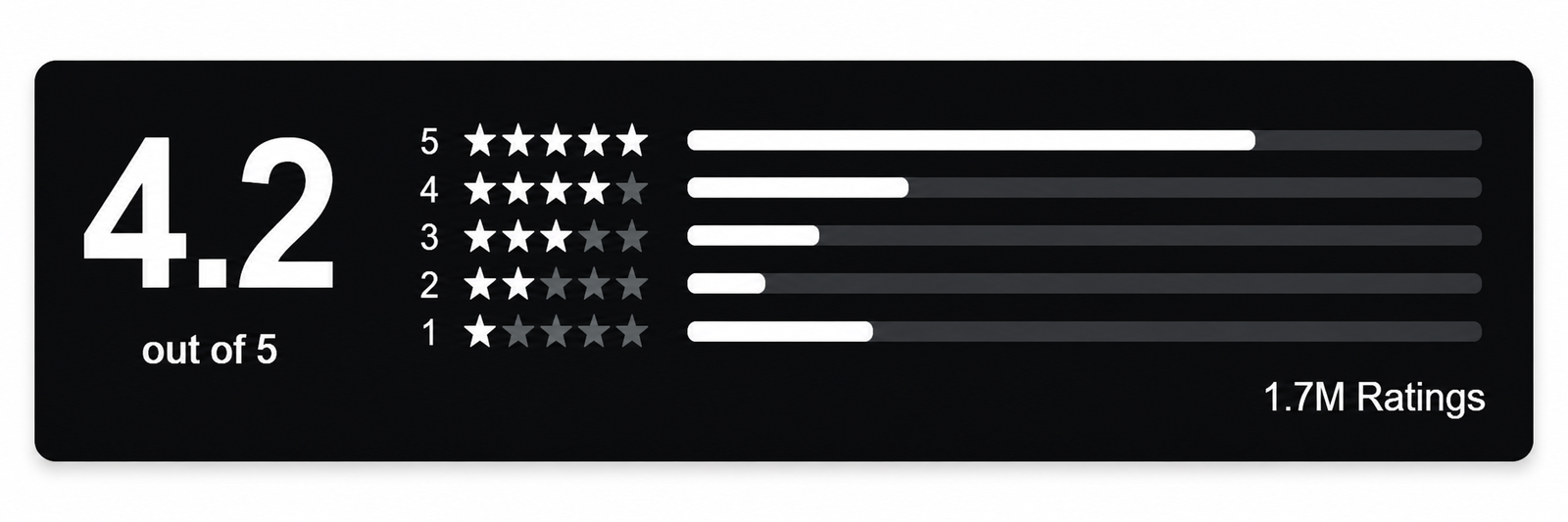
Registration
Sign up via phone number, Google, or Facebook. Bumble requires users to be at least 18.
-
Profile setup
Photos, a bio, and optional prompts; users choose Date, BFF (now a separate app), or — historically — Bizz networking modes.
-
Verification
Photo verification confirms a selfie matches profile photos; a government-ID-based verification badge is also available in several markets.
-
Matching
Swipe right to like, left to pass. On a mutual right-swipe in a woman/man match, the woman must send the first message within 24 hours, or the match expires; "Opening Moves" lets men respond to a prompt instead of waiting.
-
Messaging
Opens after a match, subject to the 24-hour first-message window.
-
Daily usage
Free accounts have a capped number of swipes and one "Best Bee" match suggestion per day.
Bumble Features Review
-
Women-First Messaging & Opening Moves
The foundational rule remains: women message first in opposite-sex matches. Opening Moves (introduced in 2024) lets men set a prompt that women can respond to instead, effectively letting men "go first" within Bumble's structure.
-
Beeline
A queue showing everyone who's already swiped right on you so you can match instantly rather than swiping blind. It's the single feature most reviewers point to as the strongest reason to pay for Premium or Premium+.
-
Boost, Backtrack, Rematch & Extend
Entry-level paid tools: unlimited swipes, undoing an accidental left swipe, reviving expired matches, and adding 24 hours to a match's countdown.
-
Travel Mode, Advanced Filters & Incognito
Premium-tier tools for changing your location before a trip, filtering more precisely (education, lifestyle, and more), and browsing without appearing in others' feeds.
-
AI Profile Guidance & Photo Feedback
Launched in February 2026, these tools give AI-suggested feedback on bios and prompts, and (in the US) evaluate a photo library to suggest which images to use. Bumble's own data shows strong profiles with a few prompts get meaningfully more responses.
-
Bumble 2.0 and "Bee"
The biggest change on the horizon: Wolfe Herd announced in May 2026 that Bumble is phasing out swiping altogether in favor of a rebuilt, AI-enabled experience, including an AI assistant ("Bee") intended to help members find and connect with matches more directly. Full rollout is expected in select markets later in 2026.
-
Safety Tools
Deception Detector, Private Detector, ID Verification, Share Date, and Review Before You Send — covered in full below.
Bumble Pricing in 2026
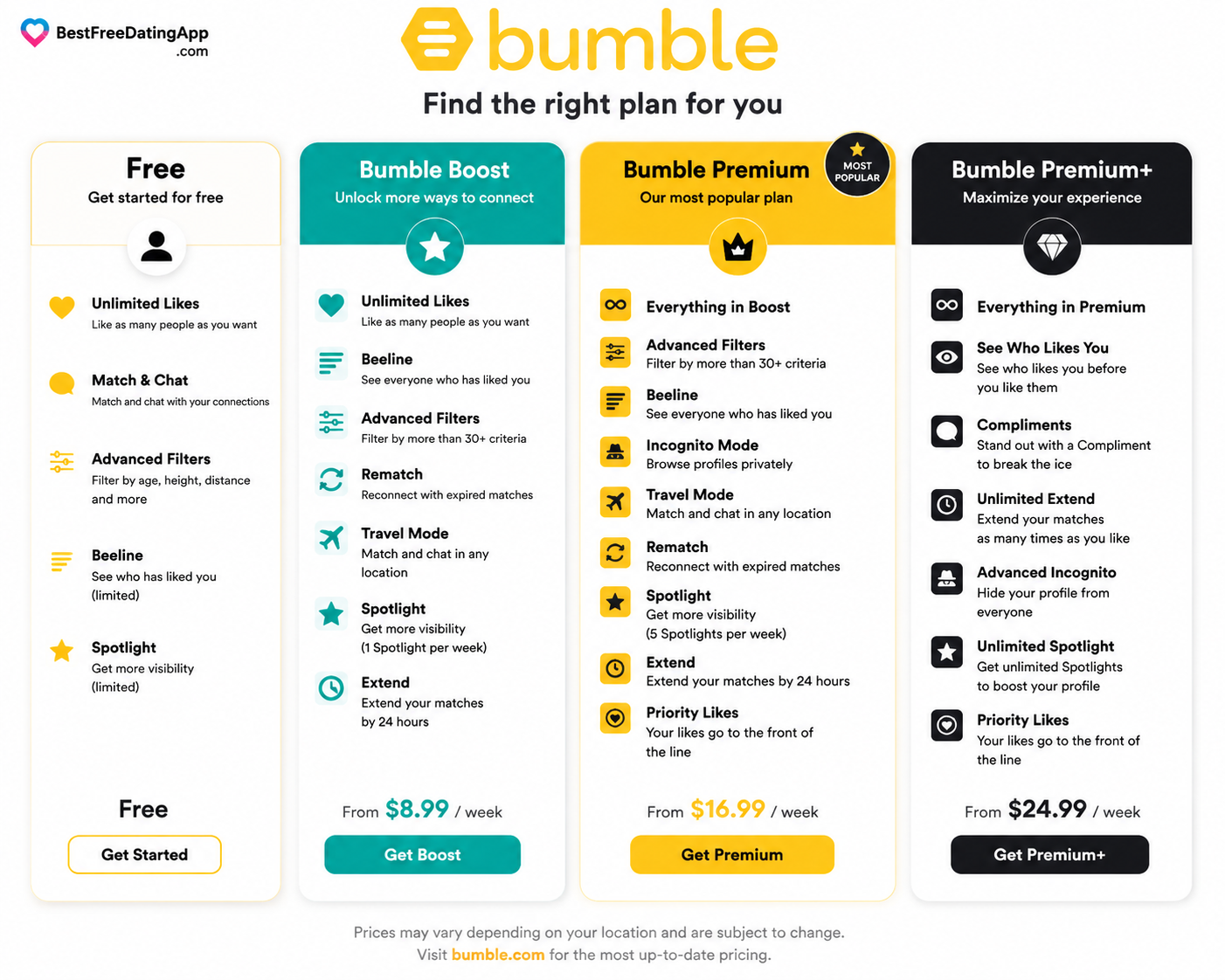
Like most major dating apps, Bumble uses dynamic pricing that varies by age, location, and plan length, so quoted figures below are representative rather than fixed:
|
Plan
|
Typical Monthly Price*
|
What You Get
|
|---|---|---|
|
Bumble Free
|
$0
|
Core swiping, one Best Bee match/day, 24-hour messaging window
|
|
Bumble Boost
|
~$18–$40/mo
|
Unlimited swipes, unlimited Backtrack, Rematch, Extend, weekly Spotlight, weekly SuperSwipes
|
|
Bumble Premium
|
~$33–$40/mo
|
Everything in Plus, plus Likes You and Top Picks
|
|
Bumble Premium+
|
~$80–$100/mo
|
Everything in Premium, plus Priority Likes, daily visibility boosts, and access to the Trending tab
|
*Weekly plans and one-off purchases (extra SuperSwipes, Spotlights) are also available; multi-month plans generally lower the effective monthly cost.
Is Premium worth it? Beeline is the feature that changes the experience most — seeing who’s already interested removes the guesswork of blind swiping, and it’s the reason most reviewers recommend Premium over Boost for people who are already getting some likes. Premium+’s added visibility perks are a harder sell for casual users and make more sense in competitive, high-density dating markets. Boost alone is a reasonable low-cost test if your main frustration is running out of swipes or losing expiring matches, rather than not getting matches at all.

User Interface & Experience
Bumble’s interface follows the same swipe-card format popularised by Tinder, with its signature yellow-and-black branding and a running countdown timer on new matches that creates real urgency to send that first message. The 2026 AI Profile Guidance tool now surfaces directly in profile editing, nudging users toward stronger bios as they build their profile.
The app is available on iOS, Android, and the web, and separate standalone apps now exist for Bumble BFF (friendship) rather than a single app with mode-switching. Users consistently note the countdown timer and unlimited-swipe monetisation prompts as the most friction-heavy parts of the free experience.
Performance: Matches, Activity & Reliability
Bumble’s own first-quarter 2026 results show a business intentionally trading user volume for quality: total paying users fell 21% year-over-year to 3.2 million, while revenue per paying user rose nearly 9%. Company leadership has framed this explicitly as a “reset” of the member base — removing low-quality and inactive accounts — ahead of the planned AI-driven relaunch later in 2026.
On the ground, user reviews describe a mixed experience: matches and message volume vary heavily by city and user density, the app has been reported to slow down under heavy usage, and the 24-hour message timer is a frequent point of frustration when a promising match simply expires unanswered.
Safety & Privacy
Bumble has invested heavily and publicly in safety tooling, and its official Safety Center lists a substantial set of protections:
- Deception Detector™ — AI-based detection of fake, spam, and scam profiles.
- Private Detector — Automatically detects and blurs unsolicited explicit images before a recipient opens them.
- ID Verification — A government-ID-based badge, available in the US, UK, Australia, Canada, France, India, Ireland, Spain, Germany, Mexico, and New Zealand, with more markets planned.
- Review Before You Send — Flags potentially inappropriate messages before they’re sent.
- Share Date — Send a match’s profile plus your date’s time and location to someone you trust.
- Snooze — Pause your account entirely without deleting it.
- Content policy — No weapons in profile photos, and zero tolerance for hate speech, harassment, or fetishization, per Bumble’s published community guidelines.
The honest caveat: despite this tooling, unexplained account suspensions are one of the most consistent complaints across independent review platforms — several users report being banned over messages or photos that, in their account, didn’t violate any policy, with a slow and often unhelpful appeals process. Fake and inactive profiles are also a recurring complaint, though less dominant than the ban-related frustration. As with any dating platform, standard precautions still apply: video chat before meeting, meet in public, and use Share Date for extra peace of mind.
Pros
-
Genuine women-first structure
The core mechanic isn't cosmetic; it measurably changes who contacts whom.
-
Beeline earns its keep
Seeing confirmed interest before swiping is a real, tangible upgrade over blind swiping.
-
Serious safety investment
Deception Detector, Private Detector, ID Verification, and message screening go further than many competitors.
-
Active product development
Opening Moves, AI Profile Guidance, and the upcoming AI-driven relaunch show continued investment rather than stagnation.
-
BFF option
A legitimate path to platonic connections, now developed as its own standalone app.
-
Improving profitability
Bumble Inc.'s recent earnings show real margin discipline, suggesting the company isn't in financial distress despite a shrinking user base.
Cons
-
Unexplained account bans
The single most consistent complaint across review platforms, often with little clarity on what triggered it or how to appeal.
-
Premium+ is expensive
At roughly $80–$100/month, it's priced well above most competitors' top tiers.
-
Shrinking paying user base
Paying users fell 21% year-over-year as of Q1 2026, a trend worth knowing about even if the company frames it as a deliberate quality reset.
-
24-hour match expiry frustrates users
A promising match can vanish before anyone gets around to writing a first message. Fake and inactive profiles — a recurring, if secondary, complaint on both major review platforms.
-
Uneven customer support
Several reviewers report long waits for a response, though a few describe eventual resolution once escalated to a manager.
Real User Reviews & Community Feedback
Ratings diverge sharply by platform, a pattern common to most subscription dating apps:
| Platform | Rating | Notes |
|---|---|---|
| Apple App Store | ~4.3 / 5 | 1M+ ratings |
| Google Play | ~3.7 / 5 | Lower than iOS, consistent with most dating apps |
| Trustpilot | ~1.2 / 5 | Thousands of reviews, heavily complaint-driven |
| ConsumerAffairs | Low, similar pattern | Millions of reviews across the platform overall |
The App Store and Google Play numbers reflect a broad, mostly satisfied-enough user base that rates the app in passing; Trustpilot and ConsumerAffairs skew toward people motivated enough by a bad experience to write a detailed complaint. Reading through both platforms, a few themes come up far more than others:
- Bans with no clear cause — by far the most repeated complaint, including profiles suspended over ordinary photos or messages that reviewers say didn’t violate any stated policy, with appeals that go unanswered for weeks.
- Billing mix-ups — being charged for the wrong plan length or discovering a “lifetime” purchase didn’t survive an account suspension.
- Fake or inactive profiles, including suspected bots continuing conversations on expired accounts.
- Matches outside stated distance preferences — a specific, recurring complaint about the location filtering not being respected.
- Slow performance during high usage, especially for frequent travellers.
It isn’t uniformly negative: several reviewers, including long-time members, describe genuinely better-quality conversations than on competing apps, and Bumble’s own product announcements point to concrete engagement gains tied to stronger profiles.
Note for your editorial team: the themes above are paraphrased, not verbatim, per copyright limits on reproducing user-generated reviews. For exact quotes, pull directly from trustpilot.com/review/bumble.com (also check regional editions), consumeraffairs.com/entertainment/bumble.html, and the App Store/Google Play listings filtered by star rating.
Expert Analysis
Bumble’s 2026 story is really two stories at once. The first is a genuine identity, a decade in: the women-first mechanic isn’t a gimmick, and it’s clearly shaped who uses the app and why, even as Opening Moves has softened its edges. The second is a company in the middle of a hard strategic pivot — deliberately shedding paying users to improve platform quality, while preparing to abandon swiping itself in favour of an AI-driven successor product later this year.
That’s an unusually candid bet for a public company to make out loud. Shrinking the paying base by a fifth in a single year while profits jump is a strategy that only pays off if the promised relaunch actually lands — and Wolfe Herd, back in the CEO seat after a 14-month break, is staking her second act on getting it right. In the meantime, the app that exists today is a reasonably strong, safety-forward product weighed down by a persistent, well-documented moderation problem that the company hasn’t yet solved.
Tinder vs. Other Dating Apps
| App | Best For | Typical Premium Starting Price* | Standout Feature |
|---|---|---|---|
| Bumble | Women-first messaging, casual-to-serious | ~$18–$40/mo | Women (or a chosen Opening Move) send the first message |
| Tinder | Broadest reach, casual-to-serious | ~$25/mo | Massive global user base, swipe simplicity |
| Hinge | Relationship-focused daters | ~$33/mo | Prompt-based profiles; “designed to be deleted” |
| OkCupid | Compatibility-driven matching | Varies by market | In-depth compatibility questionnaire |
| Badoo | Global, casual social-dating | Freemium credits | Also owned by Bumble Inc.; huge international reach |
| Facebook Dating | Free daters wanting social integration | Free — no premium tier | Pulls in Facebook Events and Instagram |
*Approximate US rates; all of these apps use dynamic pricing that varies by age, location, and promotions.
Bumble’s clearest differentiator against Tinder is structural, not cosmetic — the first-message rule genuinely changes the dynamic of opposite-sex matches, which is why it consistently draws women who’ve had a frustrating experience elsewhere. Against Hinge, Bumble is the more casual, higher-volume option; Hinge’s prompt-heavy profiles and explicit relationship focus suit people who want less swiping and more context upfront. Badoo, also under Bumble Inc., mirrors Tinder’s casual, high-volume approach but leans harder into markets outside North America. Facebook Dating remains the free outlier with no premium tier at all.
Who Should Use Bumble?
- Women who want control over who initiates contact and a clear, enforced rule around it.
- Daters who value active safety tooling — Deception Detector, ID Verification, and message screening are genuinely useful.
- People interested in trying Opening Moves or the upcoming AI-driven relaunch as it becomes available.
- Anyone who wants a platform positioned toward serious connections without Hinge’s more intensive profile-building.
Who Should Avoid Bumble?
- Anyone who’s been wrongly banned on a similar platform before and wants strong assurance around appeals — Bumble’s moderation complaints are a known weak point.
- Users who dislike time pressure — the 24-hour message window is a common source of frustration.
- Budget-conscious daters who’d be tempted by Premium+ — at $80–$100/month, it’s one of the priciest tiers in the category.
- People who want a platform with a clearly growing, not shrinking, active user base.
Frequently Asked Questions
Is Tinder free to use?
Yes — you can create a profile, swipe, match, and message without paying, though free accounts face daily like limits and periodic ads.
How much does Tinder Plus, Gold, and Platinum cost?
Rates vary by age and location, but standard US pricing is roughly $24.99/mo for Plus, $39.99/mo for Gold, and $49.99/mo for Platinum, with cheaper effective rates on 6-month plans.
What is Tinder Select?
An invite-only $499/month tier for under 1% of highly active users, adding VIP-style visibility, messaging without matching, and early feature access.
Does Tinder show who liked you for free?
No — that requires Gold or Platinum. Free users only see likes as they appear in the regular swipe deck.
Is Tinder safe to use?
It offers photo/ID verification, a Noonlight-powered panic button, and message-screening prompts, but fake profiles and scams are a recurring complaint — standard precautions (video chat first, meet in public, tell a friend) still apply.
How does Tinder's matching algorithm work?
It combines swiping behavior, stated preferences, and activity patterns; an opt-in 2026 “Chemistry” feature can also analyze a user’s photos to refine matches. Tinder doesn’t publish the exact weighting.
Can I cancel my Tinder subscription at any time?
Yes, via the App Store, Google Play, or account settings — cancelling stops future renewals but typically doesn’t refund the current period.
Why did Tinder settle a lawsuit over its pricing?
It agreed to pay $60.5 million in 2026 to resolve a California class action alleging it charged users 30+ more than younger users for Plus and Gold. Age-based pricing was discontinued in 2022; Tinder hasn’t admitted wrongdoing.
Does Tinder work internationally?
Yes — it’s available in roughly 190 countries and 40 languages, and Passport (paid tiers) lets you match outside your current location.
What age group uses Tinder the most?
Most users are 18–34, and Generation Z now makes up more than half of Tinder’s global user base.
Is Tinder better for casual dating or serious relationships?
It varies by user — Tinder’s own data suggests roughly half its users want something serious. Hinge is more explicitly structured around relationship-seeking from the start.
Does Tinder still offer background checks on matches?
It previously partnered with nonprofit Garbo for paid background checks, but that partnership ended in 2023. Check the in-app Safety Center for what’s currently available.
How do I verify my profile on Tinder?
Photo Verification uses a selfie matched against posing prompts; ID Verification, where available, adds an optional government-ID check.
Does Tinder have a desktop or web version?
Yes, though the web version has fewer features than the mobile apps.
Is Tinder better than Bumble or Hinge?
Depends on intent: Tinder has the largest match pool and simplest interface, Bumble puts women in control of the first message, and Hinge is built around long-term relationships over casual swiping.