
Bumble Dating App Review: Features, Pricing, Safety and How It Works
What Is Bumble?
Bumble is a dating, friendship, and networking app founded in 2014 by Whitney Wolfe Herd, a co-founder of Tinder. Its defining mechanic — in matches between a man and a woman, the woman has to send the first message within 24 hours or the match expires — has been part of the app since launch and remains its core differentiator.
Bumble now operates in three modes inside one app: Date (dating, the focus of this review), BFF (platonic friendships), and Bizz (professional networking). The company also owns Badoo, a separate, older dating app with a different interface and no first-move rule, and has more recently added Official (an app aimed at couples).
Bumble Inc. is a publicly traded company (NASDAQ: BMBL), headquartered in Austin, Texas.
How Does Bumble Work?
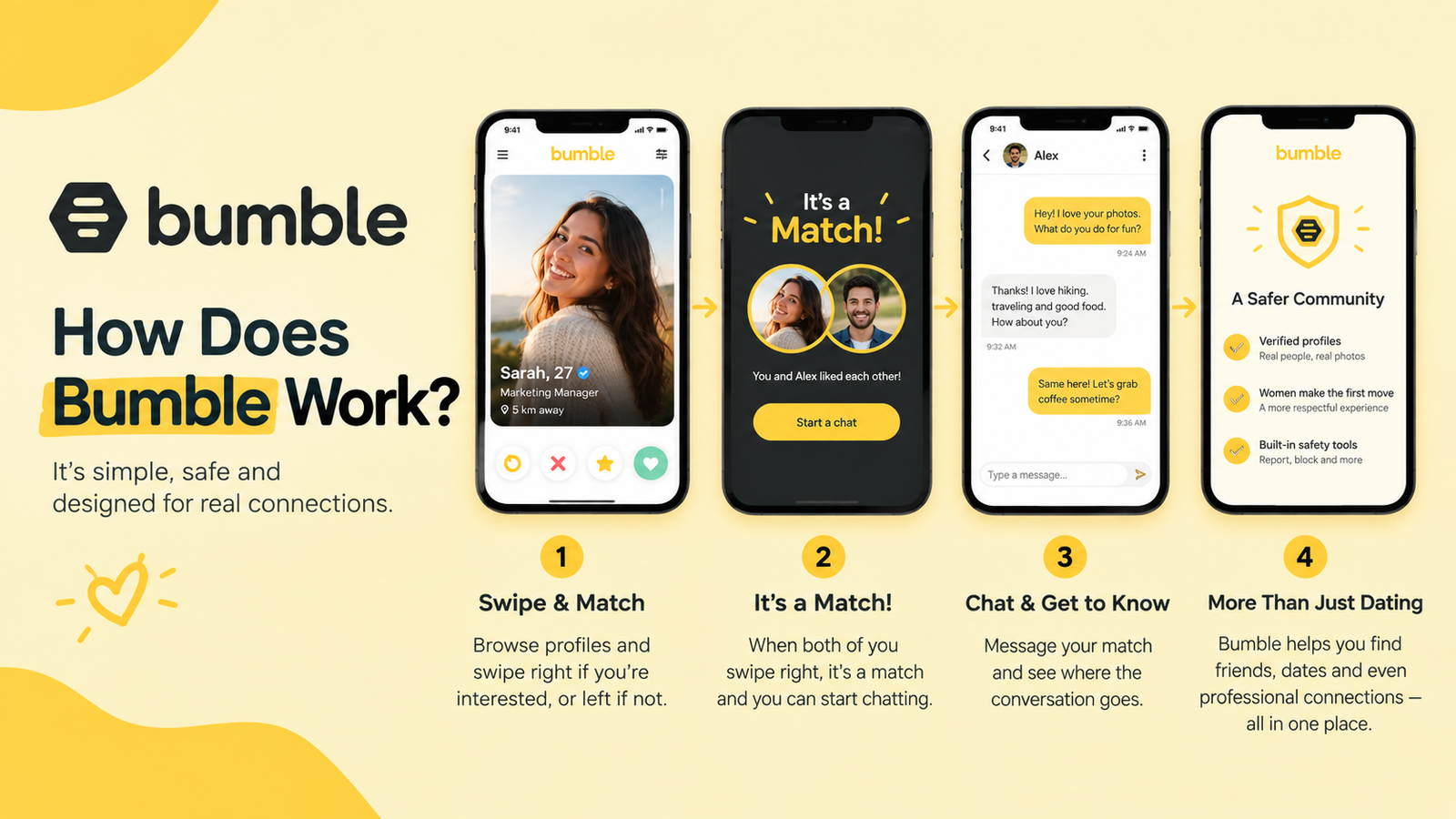
After creating a profile, users browse other profiles one at a time and swipe right to like or left to pass. When two users swipe right on each other, it’s a match. From there, the app’s central rule applies to male-female matches: the woman has 24 hours to send the first message, or the match disappears. In same-gender matches, either person can message first. Both users can extend the countdown by 24 hours once per match for free (Boost and Premium subscribers get additional Extend uses), and expired matches can sometimes be recovered using the Rematch feature.
Beyond the initial swipe-and-message loop, Bumble layers in video/voice calling, profile verification, filters, and the paid features covered below.
Creating a Bumble Profile
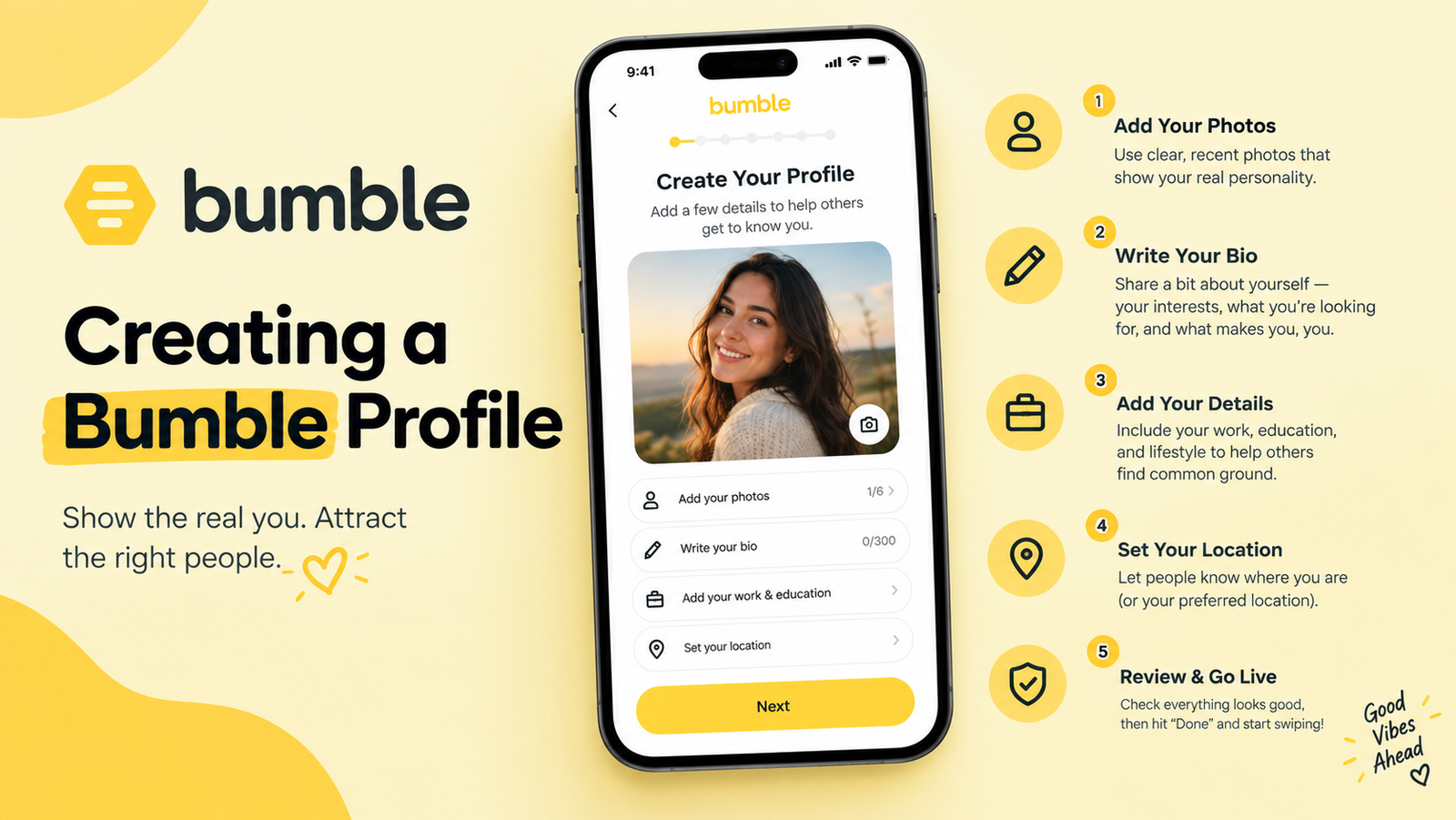
Setting up a profile requires a phone number and, at minimum, one photo. Users can add up to several more photos and a short bio and answer optional prompts (icebreaker-style questions displayed on the profile to give matches something specific to comment on). Users set their gender, the gender(s) they’re interested in seeing, an age range, and a search radius.
Bumble previously required linking a Facebook account for signup; this is no longer mandatory, though some older accounts remain linked to Facebook from when it was required. Profile completeness affects visibility in the discovery deck, though Bumble does not publish the exact weighting of its matching algorithm.
Best dating apps 2026
- September 13, 2026
Tinder Bio for Men: Best Examples, Ideas & Tips (2026)
- July 24, 2026
Tinder

- September 20, 2026
Senior Dating in 2026: Best Sites, Real Costs & Safety

- August 13, 2026
OkCupid

- September 24, 2026
Bumble vs Hinge Privacy Settings: Which Dating App Protects You Better?
- September 24, 2026
Bumble
Bumble's Main Features
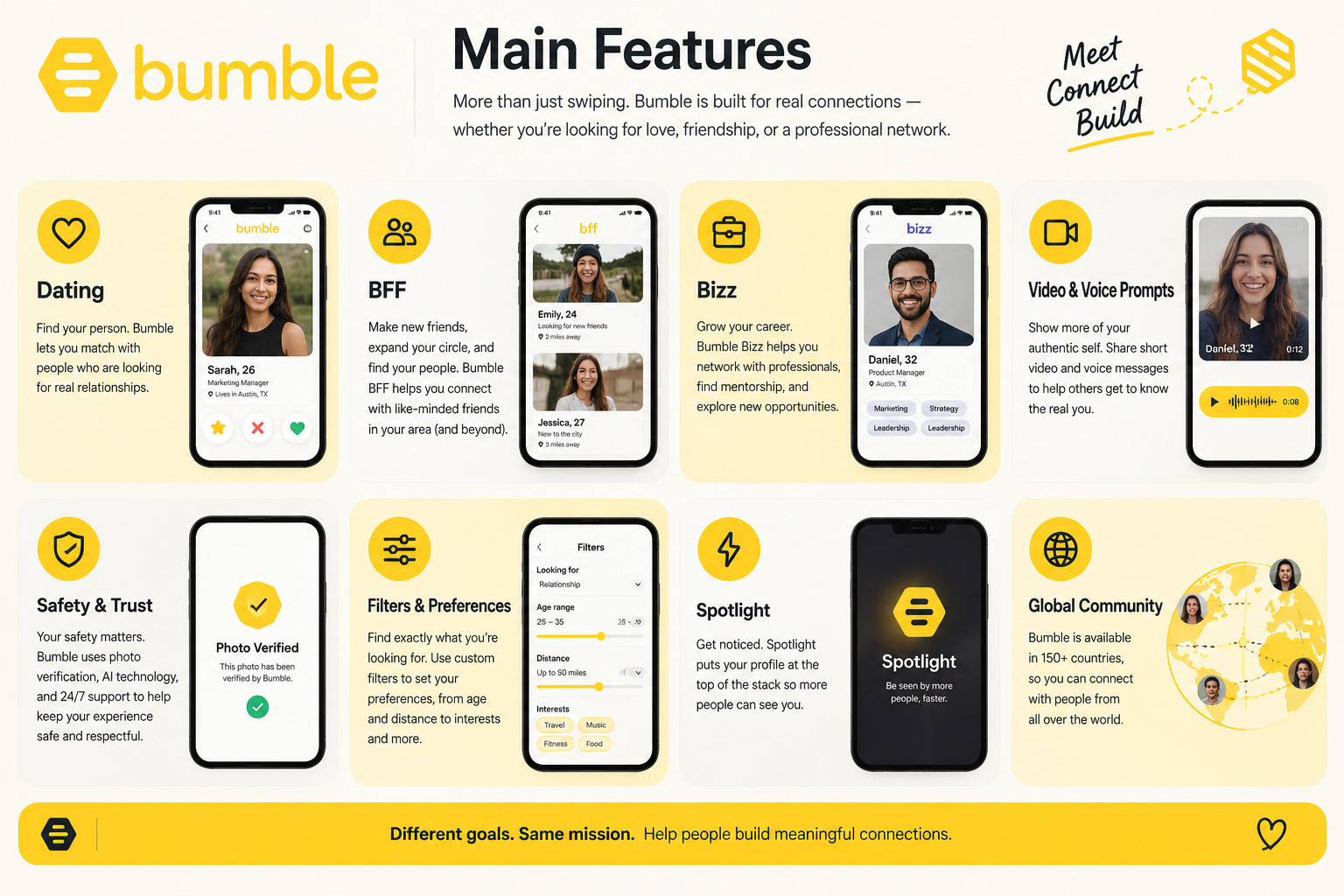
| Capability | Free | Paid (Boost/Premium/Premium+) |
|---|---|---|
| Create a profile and browse matches. | Yes | Yes |
| Swipe and match. | Yes, with some daily swipe limits reported by users | Unlimited likes from Boost tier up |
| Message a match. | Yes, once matched | Yes |
| See who already liked you. | No | Yes (premium and above — Beeline) |
| Advanced filters | No | Yes (premium and above) |
| Travel Mode / Incognito Mode | No | Yes (premium and above) |
| Extend a match’s countdown. | Once per match, free | Additional extensions (Boost and above) |
| SuperSwipes / Spotlights | Available to purchase individually | Weekly allotment included (Boost and above) |
| Rematch expired connections | No | Yes (Boost and above) |
| Voice/video calls, verification, reporting, blocking | Yes — these are not paywalled. | Yes |
Matching
Matching works on the mutual swipe-right model common to most major dating apps. Bumble does not publicly disclose the full mechanics of how it orders profiles in the discovery deck, though it has said in public statements that engagement and mutual interest signals affect who gets shown to whom.
Messaging
Once matched, the male-female 24-hour first-message rule (described above) governs who can speak first. In-app voice and video calls are available without sharing a phone number, which Bumble’s own safety materials frame as a way to vet a match before exchanging personal contact details.
Profile Verification
Bumble offers two layers of verification, per its official Support documentation:
- Photo Verification: users take a real-time selfie matching specific poses, which is compared against their profile photos to confirm the person in the pictures is the one using the account.
- ID Verification: an additional, optional layer that verifies identity against a government-issued ID for extra trust.
Verified profiles display a badge, but verification is not mandatory to use the app.
Filters
Free users can filter by basic criteria (age range, distance, and gender preference). Premium and Premium+ subscribers unlock Advanced Filters, which narrow results by additional criteria such as lifestyle preferences, though the exact filter list can change and is best checked in-app.
Premium Tiers (Boost, Premium, Premium+)
Bumble’s official support documentation (last updated August 10, 2026) describes three subscription tiers plus standalone purchases:
Bumble Boost includes:
- Unlimited likes
- 5 SuperSwipes a week
- 1 spotlight a week
- Ability to extend a match’s messaging window by 72 hours
- Rematch with expired connections
- Unlimited Backtrack (undo an accidental left swipe)
Bumble Premium includes everything in Boost, plus:
- Beeline (a queue showing everyone who has already swiped right on you)
- Advanced Filters
- Incognito Mode (your profile is only shown to people you’ve already swiped right on)
- Travel Mode (change your shown location)
Bumble Premium+ includes everything in Premium, plus:
- Exclusive photo insights (see which of your photos perform best)
- Priority placement so matches see your profile sooner
- 2 Notes, 10 SuperSwipes, and 2 Spotlights per week
Consumables
Outside of subscriptions, Bumble sells one-off purchases: SuperSwipe (signals strong interest before a match), Spotlight (temporarily boosts profile visibility), and Notes (sends a message referencing a specific photo or prompt before matching — previously called Compliments).
Bumble Pricing and Subscription Plans
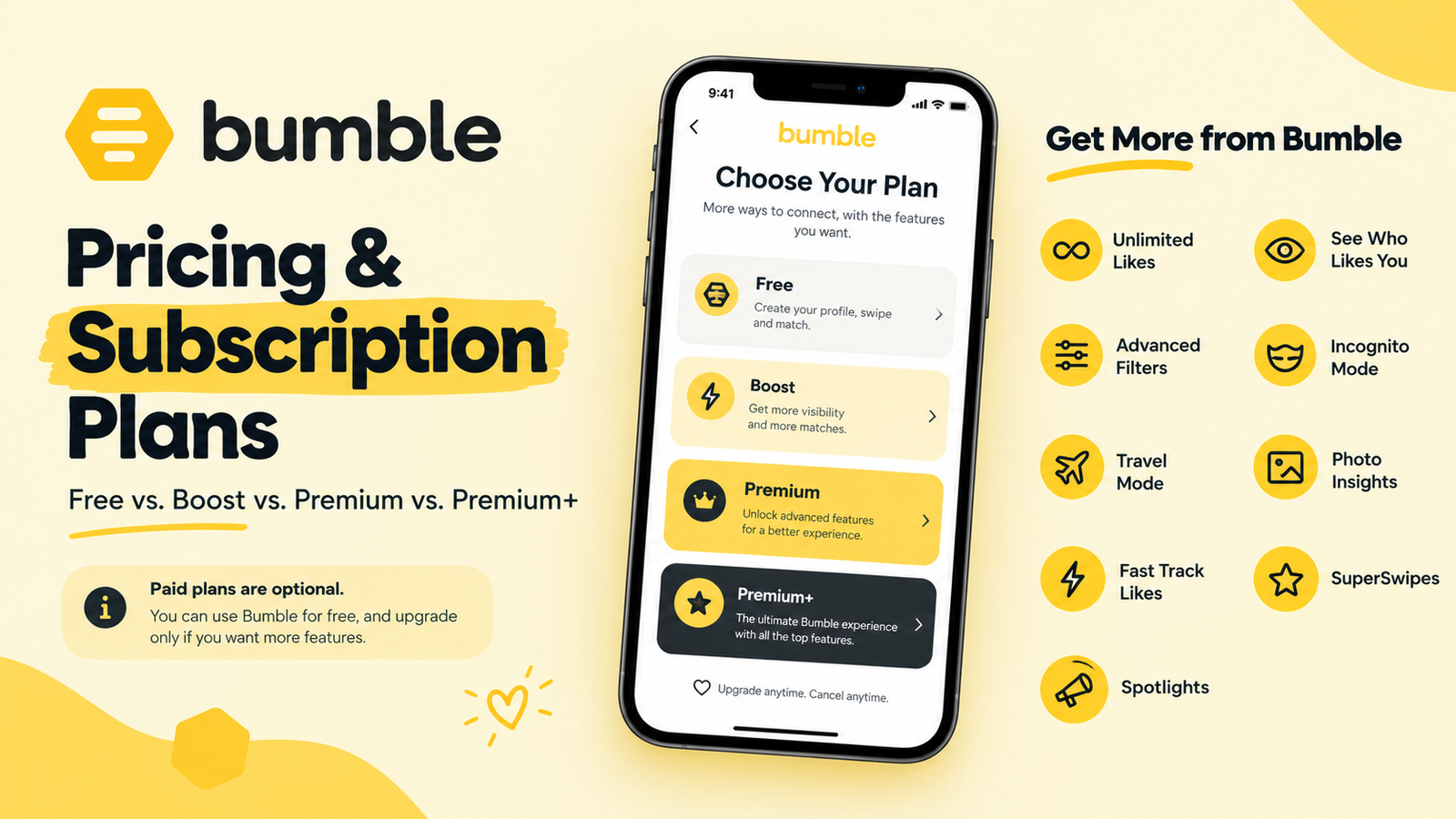
| Tier | Reported Monthly Range (unverified, varies by source) | Confirmed Features |
|---|---|---|
| Boost | Roughly $3–$13 (varies by package size, per independent review) | Unlimited likes, 5 SuperSwipes/week, 1 Spotlight/week, 72-hour Extend, Rematch, unlimited Backtrack |
| Premium | Reported between roughly $30 and $60/month across different reviews | Everything in Boost + Beeline, Advanced Filters, Incognito Mode, and Travel Mode |
| Premium+ | Reported around $80/month in one detailed review | Everything in Premium + photo insights, priority placement, 2 Notes/10 SuperSwipes/2 Spotlights weekly |
This is the section where readers should apply the most scrutiny, including to this article. Here is what’s verifiable and what isn’t.
Verified, from Bumble’s own Support page (updated August 3, 2026): Bumble does not publish a fixed, universal price list. Its own documentation states that cost “may vary based on the subscription tier, duration, and package size,” and directs users to check exact pricing inside the app, under the profile icon → “Pay plan” tab. Bumble also confirms it runs periodic promotions, delivered as in-app banners, with no redeemable promo code system as of this writing.
Not verified with confidence — reported ranges only: Independent reviewers checking Bumble’s pricing in 2026 report substantially different numbers from each other. Monthly premium pricing has been reported anywhere from roughly $30 to $60, and Premium+ has been reported as high as $80/month in at least one review, with shorter-duration weekly plans running higher per week and multi-month plans running lower per month. Boost has been reported in the roughly $3–$13 range depending on package size. Given how widely these figures vary between reviewers checking at different times, from different locations, and possibly with different account histories, none of them should be treated as a current, universal price.
Practical takeaway: treat any number you read online — including the ranges above — as a rough guide, not a quote. Check the actual price in the app before assuming what you’ll pay, since Bumble explicitly designs pricing to vary by these factors rather than publishing one number.
Free vs. Paid: What You Actually Get
| Capability | Free | Paid (Boost/Premium/Premium+) |
|---|---|---|
| Create a profile and browse matches. | Yes | Yes |
| Swipe and match. | Yes, with some daily swipe limits reported by users | Unlimited likes from Boost tier up |
| Message a match. | Yes, once matched | Yes |
| See who already liked you. | No | Yes (premium and above — Beeline) |
| Advanced filters | No | Yes (premium and above) |
| Travel Mode / Incognito Mode | No | Yes (premium and above) |
| Extend a match’s countdown. | Once per match, free | Additional extensions (Boost and above) |
| SuperSwipes / Spotlights | Available to purchase individually | Weekly allotment included (Boost and above) |
| Rematch expired connections | No | Yes (Boost and above) |
| Voice/video calls, verification, reporting, blocking | Yes — these are not paywalled. | Yes |
The core loop — creating a profile, browsing, matching, and messaging — is fully usable without paying. The paid tiers add visibility, control, and convenience features rather than gating the basic ability to date on the app.
Registration takes a few minutes: phone verification, basic profile details, and photos. Discovery uses a full-screen card swipe interface. Matching and messaging happen in a fairly standard chat layout, with the countdown timer displayed prominently on new matches so users know how much time remains. Notifications alert users to new matches, messages, and expiring countdowns.
As of August 2026, Bumble’s own support documentation confirms the web version of Bumble has been discontinued — users attempting to sign in via browser are now redirected to download the mobile app instead. This is a substantive, recent change: older reviews and guides that describe using Bumble on desktop are describing a version of the product that no longer exists. Bumble’s stated reason is to concentrate features (push notifications, in-app calls, more accurate location matching, Travel Mode, and Incognito Mode) on mobile.
Overall usability is generally described as straightforward by reviewers, with the swipe-and-24-hour-timer format being simple to learn even for people new to dating apps — the main friction points reported by users relate to account moderation and billing rather than navigation (see below).
Safety and Privacy
Bumble publishes a specific, documented set of safety features (Support page, last updated March 3, 2026):
- Photo Verification and ID Verification — described above
- In-app voice and video calls — lets users vet a match before sharing a phone number
- Private Detector — automatically blurs images it detects as potentially explicit, letting the recipient choose whether to view them
- Deception Detector™ — described by Bumble as an AI-powered tool working alongside a human moderation team to flag and prevent scams
- Block and Report tools, plus an Unmatch feature that removes a connection at any time
- Snooze mode — lets a user pause visibility on the app temporarily without deleting their account
- Community Guidelines banning weapons in photos, hate speech, sexual harassment, and fetishisation content
- A stated 24/7 global moderation team monitoring for fake profiles, spam, and guideline violations
Bumble states that reports are actionable even after unmatching and that users can involve law enforcement directly for serious incidents.
What this does not mean: Bumble does not claim, and this article does not claim, that these tools make the platform free of fake profiles or scams — no dating app can credibly claim that. What’s verifiable is that these specific tools exist and are documented; how consistently they catch bad actors in practice is not something this article can independently verify, and user reports (below) suggest real inconsistency, particularly around moderation decisions and appeals.
A safety note beyond Bumble’s own materials: search results for Bumble pricing surfaced at least one third-party website reselling Bumble subscriptions at a steep discount through payment methods like PayPal and cryptocurrency. Purchasing a subscription this way is not an official Bumble transaction, isn’t protected by Bumble’s or the App Store/Google Play’s standard purchase protections, and risks violating Bumble’s terms of service in ways that could get an account banned. The only pricing shown inside the official Bumble app should be treated as the only legitimate option.
User Reviews and Common Complaints
Reviews on platforms such as Trustpilot (over 1,400 reviews at the time of research, across dozens of pages) commonly mention several recurring themes. A methodological note first: review platforms like Trustpilot are known to skew toward people motivated to leave a review after a negative experience, so this shouldn’t be read as a representative cross-section of all Bumble users — many users who have a routine, unremarkable, or positive experience never leave a review at all.
With that caveat, recurring patterns across many reviews include:
- Account moderation complaints. A significant number of reviewers describe having accounts suspended or blocked with, in their account, little or no specific explanation of which guideline was violated and describe difficulty appealing the decision.
- Billing and refund complaints. Some users report being charged for a different plan length than intended or describe difficulty getting a refund processed even after being told one was approved.
- Distance/location filter accuracy. Several reviewers report being shown matches well outside their configured distance radius.
- Response rate frustration, particularly from male users, related to the platform’s first-message structure — some describe low reply rates as a core frustration with the format itself rather than a bug.
- Fake profiles and bots, a complaint common across most swipe-based dating apps, not unique to Bumble.
- Customer support responsiveness — a number of reviews describe automated or slow support responses to account and billing issues.
Other users describe positive experiences, including successful long-term matches and satisfaction with the app’s core premise; these are less prominent in review-platform data for the reasons noted above, but they do appear consistently enough to note. Independent App Store data (below) shows a materially higher average rating than the tone of Trustpilot reviews alone would suggest, which is consistent with the idea that dissatisfied users are more likely to post detailed public complaints.
App Store ratings, checked directly against Bumble’s official listings: 4.3 out of 5 on the Apple App Store (based on roughly 1.8 million ratings, ranked around #16 in the Lifestyle category at time of check) and 4.2 out of 5 on Google Play (based on roughly 1.6 million reviews, ranked around #2 in top free dating apps, 100 million+ installs). These figures are a snapshot and will drift over time.
| Pros | Cons |
|---|---|
| Core features (browsing, matching, messaging) are usable without paying. | Bumble does not publish fixed prices; the exact cost requires checking in-app and varies by source. |
| Documented, multi-layered safety tools (photo/ID verification, Deception Detector™, Private Detector, 24/7 moderation) | Multiple user reports of account suspensions with limited explanation or appeal process |
| In-app voice/video calling before sharing personal contact details | Trustpilot reviews show recurring billing/refund complaints. |
| A distinctive first-message structure gives many women more control over initial contact. | The same structure is a common source of frustration for men, citing low response rates. |
| App Store/Google Play ratings (4.3★ / 4.2★) are solid relative to the category. | Web version discontinued in 2026 — desktop use is no longer available. |
| Three modes (Date, BFF, Bizz) in one app | User/revenue statistics from third-party trackers conflict significantly, making independent verification of “how big is Bumble” difficult. |
| Snooze mode allows a break without full account deletion. | Reported distance-filter accuracy issues in some user reviews |
Platforms: Bumble is available as a native app on iOS (Apple App Store) and Android (Google Play). The web version has been discontinued as of Bumble’s own August 2026 announcement; browser access now redirects users to download the mobile app.
Countries: Independent trackers report meaningfully different figures for how many countries Bumble operates in — figures ranging from roughly 90 to 150 to 190 countries appear across different sources and different publication dates, likely reflecting both genuine expansion over time and inconsistent sourcing between trackers. Bumble does not appear to publish a single current, definitive country count on its own site in a way this research could locate. Availability, and which paid features are offered, can also vary by country due to local laws — Bumble’s own support materials note that paid features aren’t offered everywhere for regulatory reasons.
User base: Similarly, third-party estimates of monthly active users vary widely — from roughly 35 million to 50 million depending on the source and year cited — as do paying-subscriber estimates (most commonly cited in the low single-digit millions, though this also varies by source). Where sources conflict substantially, exact figures should be treated as directional rather than precise.
| Bumble | Tinder | Hinge | OkCupid | Match | Badoo | |
|---|---|---|---|---|---|---|
| Free version | Yes, functional. | Yes, functional. | Yes, limited. | Yes, functional. | Yes, browse-only. | Yes, functional. |
| Who messages first? | Woman, in male-female matches (24-hr window) | Either party | Either party | Either party | Either party | Either party |
| Core discovery model | Swipe | Swipe | Prompt/profile-based | Compatibility questions + browse | Search + suggested matches | Swipe |
| Verification | Photo + optional ID verification | Photo verification | Available | Available | Available | Photo verification |
| Web version | Discontinued (2026) | Available | Available | Available | Available | Available |
| Owned by | Bumble Inc. | Match Group | Match Group | Match Group | Match Group | Bumble Inc. |
| Key differentiator | Women message first; BFF/Bizz modes | Largest user base by most measures | Prompt-based profiles designed for relationships | Detailed compatibility questionnaire | Skews toward older, commitment-focused users | No first-move rule; large international base |
This table reflects structural and policy differences, not a ranking. Which of these differences matters most — a first-move structure, a prompt-based profile format, or a compatibility questionnaire — depends entirely on what an individual user wants from a dating app, and no single app wins across every category for every person.
Readers who find Bumble’s specific model (the first-message rule, its price range, or its moderation approach) doesn’t fit them have several well-established alternatives, each with a different core mechanic: Tinder for the largest raw pool of profiles, Hinge for a prompt-based format orientated toward relationships rather than volume, OkCupid for compatibility-question-driven matching with a typically lower price point, Match for an older, more commitment-orientated user base, and Badoo, Bumble Inc.’s own sister app, for a swipe-based format without the first-message restriction.
Based on the evidence gathered here: Bumble’s core product is free to use in a genuine, non-crippled way, its safety documentation is more specific and detailed than many competitors publish, and its App Store/Google Play ratings are solid for the category. Its distinctive first-message structure is a real differentiator that appeals strongly to some users and frustrates others — that split is a feature of the design, not a flaw to be fixed.
The clearest documented weak points are on the operational side rather than the product concept: pricing that isn’t transparently published anywhere outside the app and a recurring pattern in user reviews around account moderation decisions and billing support that Bumble’s own marketing materials don’t address. Whether Bumble is “worth it” depends heavily on whether a reader values its first-move structure and safety toolset enough to accept those operational frictions — this article can document the trade-offs; it can’t make that call for an individual reader.


Frequently Asked Questions
Bumble is a dating, friendship, and networking app, best known for requiring women to send the first message in male-female matches within 24 hours. It operates as three modes — Date, BFF, and Bizz — inside one app.
Yes. Creating a profile, browsing, matching, and messaging are all available without payment. Paid tiers (Boost, Premium, and Premium+) add features like seeing who liked you, advanced filters, and extra visibility tools.
Users swipe through profiles; mutual right-swipes create a match. In male-female matches, the woman must send the first message within 24 hours, or the match expires. Same-gender matches don’t have this restriction.
Bumble documents a specific set of safety tools, including photo and ID verification, an AI-assisted scam-detection system (Deception Detector™), automatic blurring of explicit images (Private Detector), and 24/7 moderation. These tools are real and documented, but no dating app can be described as completely free of fake profiles or bad actors, and user reviews indicate real, recurring frustration with how moderation decisions are communicated.
Bumble does not publish a fixed price. It varies by tier (Boost, Premium, and Premium+), subscription length, and package size and is shown only inside the app under the “Pay plan” tab. Independently reported estimates vary widely — roughly $3–$13 for Boost packages and a wide range for Premium and Premium+ — so check the current in-app price rather than relying on any single quoted figure, including the ranges in this article.
It depends on what a user wants. Premium’s standout feature, Beeline, lets users see and instantly match with people who already liked them — useful for anyone finding it hard to sort through the standard swipe deck. Advanced Filters, Travel Mode, and Incognito Mode add control rather than expanding the basic ability to date on the app, which remains free.
Yes — the core functions of the app (profile, browsing, matching, messaging) work on the free tier.
Yes, through the Google Play Store.
Yes, through the Apple App Store.
No, not anymore. Bumble discontinued its web version in 2026; the platform is now mobile app-only.
Account deletion is handled in-app (Settings → account deletion option) or, per third-party guides cross-referenced for this article, via a browser at bumble.com if app access isn’t available. Deletion is permanent and erases matches and conversations. If you have an active paid subscription, Bumble’s official support documentation advises cancelling it separately first (through the App Store, Google Play, or in-app subscription management, depending on how you subscribed) — deleting the app or account alone does not automatically stop billing. Users who just want a break rather than permanent deletion can use Snooze mode instead, which pauses visibility without erasing data.
Two users match when they both swipe right on each other. The match then enters the messaging window described above, with the timer applying specifically to male-female matches.
Yes. Facebook linking is no longer required to sign up, though some long-standing accounts remain linked from when it was mandatory.
Yes — Photo Verification (a live selfie compared to profile photos) and an optional ID Verification layer, both documented on Bumble’s official Support site.
The most commonly compared alternatives are Tinder, Hinge, OkCupid, Match, and Badoo (also owned by Bumble Inc.)—each uses a different core mechanic, summarised in the comparison table above.
The most significant structural difference is who can message first: Bumble requires the woman to message first in male-female matches within a 24-hour window, while Tinder allows either matched party to message first with no time limit. Tinder is also independently reported to have a larger overall user base, while Bumble’s verification and moderation documentation is more detailed than what Tinder publishes.