
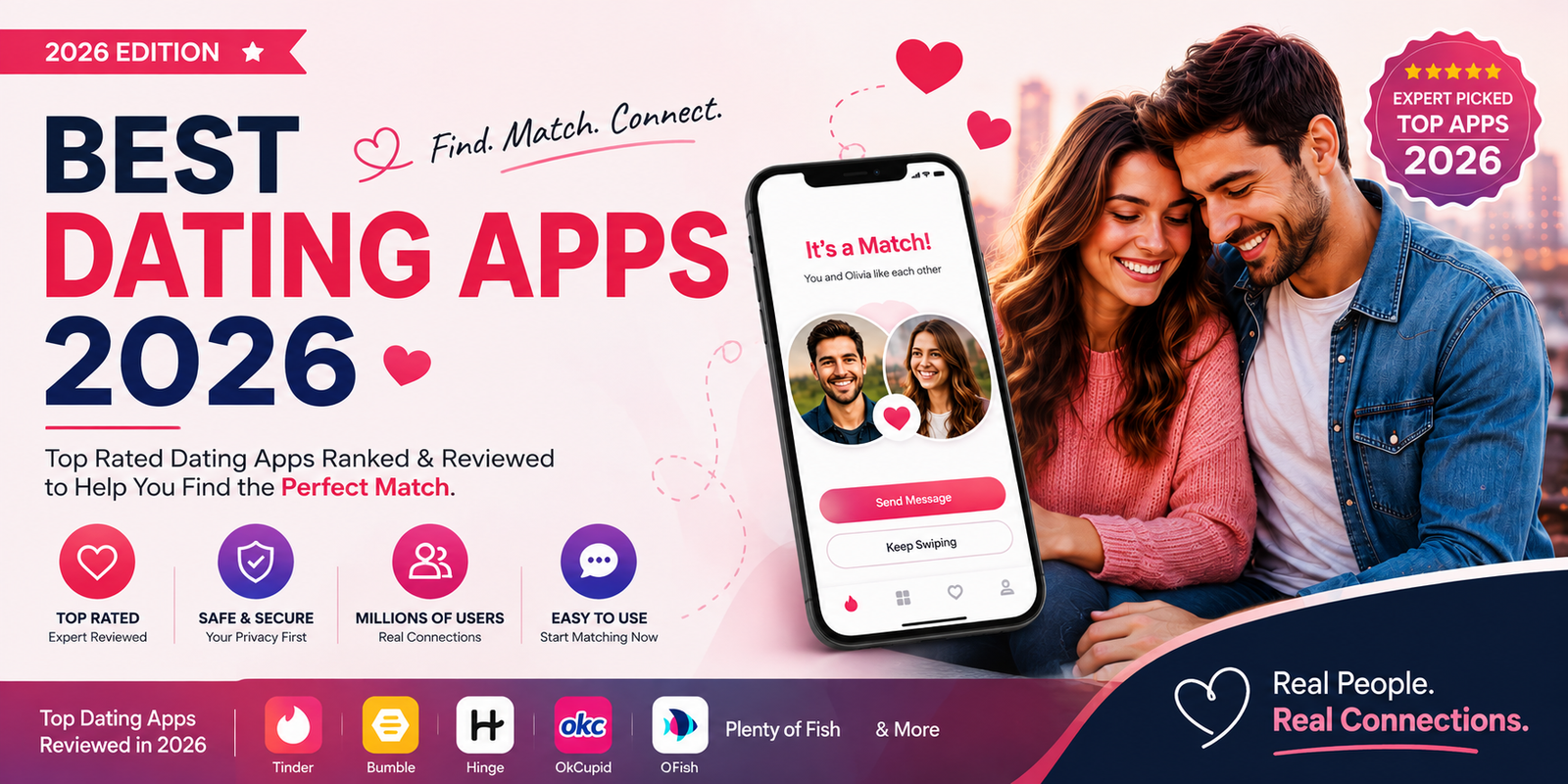
Dating apps have an image problem right now. Ask around and you’ll hear the same complaints: endless swiping, matches that go nowhere, profiles that turn out to be bots or AI-generated photos. The data backs up the frustration — according to Forbes Health’s own survey work, close to 8 in 10 dating app users report some version of burnout.
And yet people keep using them, because they still work — just not always in the way they did five years ago. The apps winning in 2026 aren’t the ones with the biggest swipe pool. They’re the ones investing in verification, smarter matching, and getting people offline and onto actual dates faster.
We pulled together pricing pages, safety disclosures, company earnings reports, and independent user data to put together this guide to the best dating apps of 2026 — what each one actually does well, what it costs, and who it’s really built for.
Quick Look for Best Dating Apps 2026
If you don’t have time for the full breakdown:
- Best overall / best for relationships: Hinge
- Best for sheer number of options: Tinder
- Best for safety-conscious daters: Bumble
- Best for marriage-minded singles: eHarmony
- Best value for money: OkCupid
- Best for daters 40+: Match.com
- Best for meeting people IRL instead of just chatting: activity-based apps
| App | Best for | Starting price* |
|---|---|---|
| Hinge | Relationships | ~$30/month |
| Tinder | Casual dating, volume | ~$25/month |
| Bumble | Women-first safety | ~$40/month |
| Match.com | Daters 40+, commitment | ~$20/month |
| OkCupid | Budget-conscious daters | ~$20/month |
| eHarmony | Marriage-minded singles | ~$36/month |
*Prices vary by term length, age, and location and change frequently—treat these as ballpark 2026 figures, not quotes.
Best dating apps 2026
- September 27, 2026
International Dating in 2026: Platforms, Safety, Scams, and the Law
- September 24, 2026
Bumble vs Hinge Privacy Settings: Which Dating App Protects You Better?
- September 24, 2026
Bumble
What's actually changed in dating apps by 2026
Three shifts explain most of what’s different this year.
AI is everywhere, for better and worse. Recent industry research (Match/Kinsey Institute) puts the number of singles using some form of AI in their dating life at roughly 1 in 4 — whether that’s an app suggesting who to message, help writing a profile, or a chatbot to rehearse conversation with before a first date. Apps use AI for matching, too, studying what you actually respond to rather than just what you claim to want in your bio. The catch is that AI cuts both ways: a growing share of users report running into AI-written messages or outright fake, AI-generated profile photos on the other end of the conversation.
Safety and verification stopped being optional. Identity verification, deepfake detection, and fraud screening used to be a nice-to-have. They’re closer to table stakes now, especially after a wave of stories about romance scams, “pig butchering” investment cons, and sextortion running through dating platforms. Bumble and Tinder have both leaned hard into AI-based photo and profile screening, and several platforms now offer optional background checks.
Growth has slowed, and apps are competing on quality instead of scale. This is a mature market now. Business of Apps puts global dating app revenue at a little over $6 billion, and it barely moved in 2025 — their data actually shows a slight dip. Match Group and Bumble, which dominate the Western market, have both watched paying-subscriber counts shrink even as they raise prices. The outlier is Hinge, which grew revenue by roughly 28% in a single recent quarter by leaning hard into its relationship-first, prompt-based pitch. The message from the market is pretty clear: people are tired of quantity and are willing to pay more for something that actually works.
Best dating apps 2026 ratings
What's actually changed in dating apps by 2026
| Dating App | ⭐ App Store | ⭐ Google Play |
|---|---|---|
| Hinge | 4.4/5—1.1M ratings | 3.5/5 — 458K reviews |
| Tinder | 4.2/5—1.7M ratings | 3.8/5—~9.0M reviews |
| Bumble | 4.3/5—1.8M ratings | 3.8/5 — 1.59M reviews |
| Match.com | 3.9/5 — 235K ratings | 3.2/5 — 149K reviews |
| OkCupid | 4.3/5 — 288K ratings | 3.4/5 — ~680K reviews |
| eHarmony | 4.1/5 — 48K ratings | 3.0/5 — ~66K reviews |
The best dating apps of 2026, one by one
1. Hinge—best overall, best for relationships
Hinge built its entire pitch around not being Tinder. Instead of swiping through photos, you respond to specific prompts and photos on someone’s profile, which hands you an actual conversation starter instead of “hey.” It’s a small design choice, but it changes the tone of the whole app — matches feel less like a numbers game.
The numbers back up the pitch. Hinge is now roughly the third-largest dating app in the US, with around 28 million users and about 15% of the market, and it’s the fastest-growing major app by revenue. Most of its users say they’re on the app looking for something serious, not a hookup.
Pricing actually came down this year: Hinge+ runs about $30/month for unlimited likes and better filters, while the top-tier HingeX (around $50/month) adds features like priority placement in someone’s queue.
One catch: the free tier is genuinely usable, but it caps how many people you can like per day, so casual browsers hit a wall fast.
2. Tinder — best for volume and casual dating
Tinder is still the biggest name in the category, and it’s not close. With around 75 million monthly active users, it has the deepest pool of profiles in almost any city, which is exactly why it remains the default choice for people newer to dating apps or anyone who wants more options in front of them.
It’s also the app most associated with the classic complaints: swipe fatigue, a heavier presence of bots and AI-generated photos, and inconsistent match quality. Tinder has responded with more aggressive photo verification and an optional paid background-check add-on, but the platform’s sheer scale makes moderation a constant uphill battle.
Pricing runs in tiers—Plus, Gold, and Platinum—landing anywhere from around $25 to $50 a month depending on your age and location.
Worth knowing: Tinder still produces more total matches and dates than any other app purely because of scale, even though its per-swipe success rate is famously low.
3. Bumble—best for safety-conscious daters
Bumble’s core idea hasn’t changed: in matches between a man and a woman, the woman has to send the first message within 24 hours or the match disappears. It’s a small rule that reshapes the whole dynamic of the app, and it’s the reason a lot of women choose Bumble over Tinder specifically.
What’s evolved is the safety layer around that idea. Bumble has invested heavily in AI-driven fraud and fake-profile detection plus selfie verification, and it markets that investment hard. There’s also a BFF mode for platonic connections and a Bizz mode for networking, so it’s less strictly a dating app than it used to be.
Growth here has flattened compared to Hinge, and some users report the local pool thinning outside big cities. Premium runs about $40/month, with a Premium+ tier around $60/month.
The tradeoff: the 24-hour timer that makes Bumble distinctive is also its most common complaint — it can turn a promising match into a countdown clock.
4. Match.com—best for daters 40+ and serious commitment
Match is one of the oldest names in online dating, and it shows in a good way: deep search filters (education, religion, family plans, lifestyle), a large user base of around 39 million people, and a gender ratio that’s close to even at roughly 49% men to 51% women — genuinely rare in this category. Its fastest-growing user group right now is 50+, and the app’s slower, profile-first pace suits that audience well.
The tradeoff is a fairly limited free version. You can browse and get suggested matches, but real back-and-forth messaging needs a paid Standard or Premium plan, running roughly $20 to $36 a month depending on the length of the term.
Worth knowing: because Match requires payment for meaningful use, the people you match with skew toward genuinely looking rather than just killing time.
5. OkCupid — best value for money
OkCupid’s whole identity is its long list of compatibility questions, covering everything from politics to whether you’d want kids someday. Answer enough of them, and the app produces a match percentage that’s a genuinely useful shortcut for figuring out who’s worth a conversation.
It’s also one of the more inclusive mainstream apps on gender identity and orientation options, and its free tier is more generous than Match’s or eHarmony’s. Premium pricing is broad—generally somewhere between $20 and $45 a month depending on the plan and whatever promotion is running.
One thing to flag: OkCupid’s user base thins out fast outside major metro areas, so how well it works depends heavily on where you live.
6. eHarmony—best for marriage-minded singles
eHarmony takes the compatibility-question idea further than anyone else, using a detailed personality model to match you rather than letting you browse and search on your own. That hands-off approach is either the app’s biggest selling point or its biggest turn-off, depending on how much control you want over who you see.
It’s also the most expensive app on this list by a wide margin — typically $36 to $60+ a month depending on term length, though steep seasonal discounts (especially around Valentine’s Day) are common. The payoff for the price is a user base that skews heavily toward people serious about finding a long-term partner or spouse.
The catch: because eHarmony won’t let you search on your own, it’s a poor fit if you like having control over who you talk to.
7. Activity-based and niche apps — best for getting offline fast
The fastest-growing corner of the market in 2026 isn’t a single app — it’s a category: apps built around meeting people through a shared activity, like a hike, a class, or a game night, rather than a photo feed. It’s a direct response to swipe fatigue, and it comes with a built-in safety advantage, since first meetings happen in group settings instead of one-on-one with a stranger.
If your goals are more specific, there’s a solid app for nearly every niche at this point: Feeld for people exploring ethical non-monogamy, Grindr for gay and bisexual men (still the dominant app in that space and posting strong revenue growth), and HER for queer women and nonbinary users.
The tradeoff: niche and activity-based apps swap a smaller user pool for a much higher chance that the people you meet actually share your specific goals.
How to actually pick one
Match quality has less to do with the app than most rankings suggest. A few things matter more:
- Be honest about what you want. Hinge and eHarmony skew toward relationships; Tinder skews casual; Match and eHarmony skew older. Picking an app that matches your actual intent saves a lot of wasted conversation.
- Your photos matter more than your app choice. Reviewers and dating coaches agree on this almost universally: a clear, recent, well-lit set of photos will outperform a mediocre profile on a “better” app nearly every time.
- Two apps beat one. Plenty of people run Hinge for relationship-focused matching and Tinder for a bigger pool, and treat the overlap as a bonus rather than a redundancy.
- Where you live matters. Niche and mid-size apps can feel empty outside major cities. If you’re not in a big metro area, lean toward the apps with the largest overall user base.
Staying safe in 2026
The uncomfortable truth about this year’s dating apps is that scams have gotten harder to spot. AI-generated photos can beat a reverse image search, and deepfake video calls are increasingly used to fake “proof” during verification. The most common scams right now cluster into a few types: catfishing built on AI-generated or stolen photos, long-con investment scams sometimes called “pig butchering,” sextortion using intimate images, and fake verification links designed to steal personal data.
A few habits go a long way:
- Keep early conversations inside the app instead of moving to text or a third-party site right away.
- Do a video call before meeting in person—ideally one where you ask them to do something spontaneous, since a scripted deepfake is much harder to fake live.
- Never send money to someone you haven’t met, no matter how good the story is.
- Meet in public for the first date, and tell a friend where you’re going.


Frequently Asked Questions
Hinge is the strongest all-around pick for most people, thanks to its relationship-first design and fast subscriber growth. Tinder still wins on the pure number of users.
Bumble and Hinge generally lead on safety and verification investment, though no app can fully guarantee a match is who they claim to be—that part is still on the user.
OkCupid and Hinge both offer genuinely usable free tiers. Match and eHarmony are the most restrictive if you’re not paying.
Depends on the app. On Hinge, premium meaningfully expands who you can see and message. On apps with generous free tiers, like OkCupid, premium is more convenience than necessity.
Mostly yes, for matching quality—apps that learn from your behavior rather than your stated preferences tend to surface better matches. Be more skeptical of AI on the other side of the conversation, since fake photos and AI-written messages are a real and growing problem.