
What Is International Dating?
International dating means pursuing a romantic relationship with someone in a different country from your own — sometimes through mainstream dating apps used with a travel or location feature, sometimes through dedicated platforms built specifically to connect people across borders. It ranges from casual, app-based matching while travelling or relocating to long-distance relationships conducted mostly by video call to relationships that progress toward a fiancé(e) or spousal visa and eventual immigration.
The category attracts a specific set of concerns that purely local dating doesn’t: language and cultural differences, time zone logistics, the practical and legal path to eventually living in the same country, and — the subject this article treats most seriously — a meaningfully higher exposure to organised romance scams, because distance itself is a tool scammers rely on.
How International Dating Actually Works
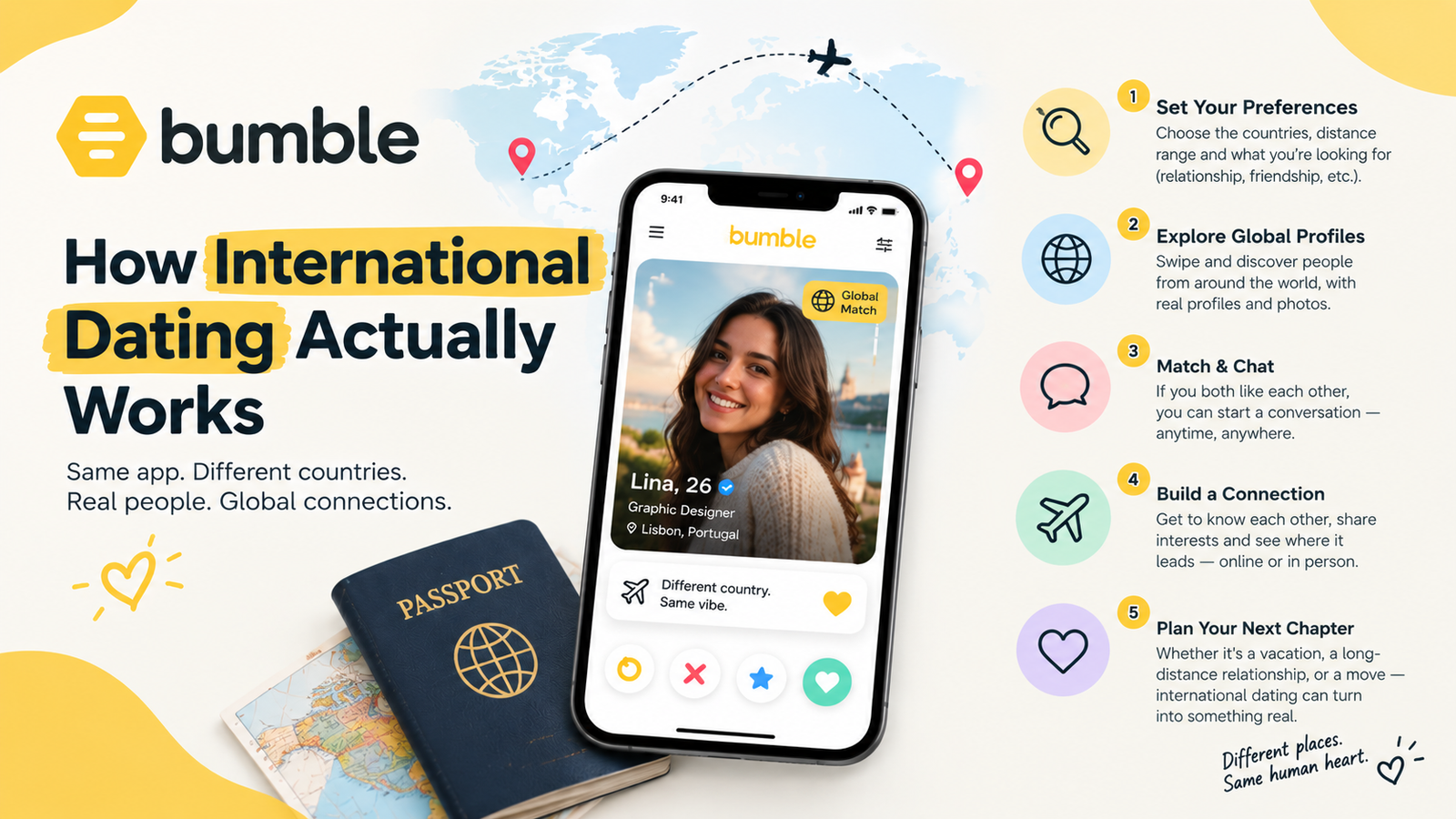
There are, broadly, two approaches, and most currently-ranking guides blur them together without distinguishing:
Approach one: mainstream dating apps used internationally. Apps like Tinder, Bumble, Hinge, OkCupid, and Match are built for local matching by default but include features (subscription-gated location changes and “worldwide” search preferences) that let users browse and match with people in other countries. These apps run the same verification, moderation, and safety infrastructure for international matches as for local ones — nothing about the experience changes structurally just because a match happens to be in another country.
Approach two: dedicated international/cross-border dating sites. These platforms are built specifically around connecting users—historically and still predominantly, men in North America, Western Europe, and Australia—with women in specific regions (Eastern Europe, Latin America, and Southeast Asia). Some are broad (InternationalCupid); many are region-specific (ThaiCupid, FilipinoCupid, RussianCupid, and similarly branded sites). This is the older, more established model of “international dating”, and it’s also the segment where this research found the most serious, documented concerns (see Section 4 below).
Mainstream Apps With International Reach
Based on official app-store data and support documentation checked in this research session (and, for Tinder Passport, Tinder’s own feature page):
Tinder offers the widest reach by raw numbers — it operates in roughly 140–190+ countries depending on the source consulted, with figures varying by publication date. Its Passport feature, bundled into Tinder Plus (reported around $24.99/month as a base price, though Tinder has been documented running age- and region-based dynamic pricing, so actual cost varies) and higher tiers, lets a user change their swiping location to any city worldwide — useful for planning matches before a trip or testing interest in a place before relocating. Tinder does not offer translation tools, so cross-language conversations typically require a separate translation app.
Bumble carries an international user base and the same women-message-first structure globally (in male-female matches). Its official documentation (checked directly in this research) confirms photo and ID verification, an AI-assisted scam-detection tool, and 24/7 moderation apply regardless of where a match is located.
Hinge is prompt-based and relationship-orientated, with a smaller but growing international footprint than Tinder or Bumble.
Match allows users to set location preferences toward “worldwide” or “global” search rather than a fixed radius, and independent trackers report it operating in 50+ countries — though, as with most statistics in this space, exact figures vary by source and should be treated as approximate.
eHarmony and OkCupid both maintain international versions, with eHarmony’s compatibility-matching model and OkCupid’s inclusive filters and questionnaire-based approach applying the same way to international matches as local ones.
None of these mainstream apps market themselves primarily as “international dating” platforms — international use is a feature within a broader product, which is precisely why they don’t carry the same structural concerns as the dedicated platforms below.
Best dating apps 2026

- September 13, 2026
Tinder Bio for Men: Best Examples, Ideas & Tips (2026)

- July 24, 2026
Tinder

- September 20, 2026
Senior Dating in 2026: Best Sites, Real Costs & Safety

- August 13, 2026
OkCupid
- September 27, 2026
International Dating in 2026: Platforms, Safety, Scams, and the Law
- September 24, 2026
Bumble vs Hinge Privacy Settings: Which Dating App Protects You Better?
Dedicated International Dating Sites — and a Pattern Worth Knowing About
This is the section where most “best international dating sites” articles compress into a glowing recommendation. The evidence gathered here suggests a more cautious approach is warranted, and this article treats two distinct clusters of sites separately because the concerns about them are different in kind.
Cluster one: the Cupid Media network
InternationalCupid.com, along with dozens of country-specific sister sites (ThaiCupid, FilipinoCupid, RussianCupid, and others), is operated by Cupid Media, an Australian company founded in 2000. Independent review data checked directly for this research is strikingly poor: InternationalCupid carries roughly a 1.8-out-of-5 rating on Trustpilot across hundreds of reviews, and other review platforms (PissedConsumer, SmartCustomer) show similarly low scores — 1.4 to 1.9 out of 5 — with thousands of reviews. The overwhelmingly recurring complaints, across all three platforms independently, are fake or scam profiles and difficulty cancelling auto-renewing subscriptions. This research did not find credible evidence that Cupid Media itself operates the staff-impersonation model described below — the concern here is closer to consistently poor fraud moderation and subscription practices than to the site itself generating fake engagement — but the review volume and consistency make this a real factor for any reader weighing this option.
Cluster two: the “pay-per-letter” network
A separate, older cluster of sites — AnastasiaDate, AsianDate, AmoLatina, and AfricaBeauties, which Wikipedia’s page on AnastasiaDate documents as commonly-owned sister sites, along with similarly modelled and similarly branded platforms such as Dream Singles, JollyRomance, and EuroCupid — connects primarily North American and Western European men with women in Eastern Europe, Asia, Latin America, and Africa, historically through a pay-per-message or pay-per-credit correspondence model rather than a flat subscription.
This is the cluster this research treats with the most caution. Multiple independent Trustpilot reviews of AnastasiaDate describe, in detail, women being paid to correspond with male members on behalf of the platform — one reviewer specifically described a personal connection who worked in this capacity, naming the practice and describing colleagues doing the same. A separate, independent discussion thread describes an identical allegation: that photos are used with hired staff, not the pictured individuals, writing the actual messages. These are user-submitted, unverified-by-this-research accounts, not a court finding or regulatory action — but their number, specificity, and independence from each other are exactly the pattern this brief’s own instructions call for treating as a real signal rather than a single anecdote.
What this means practically: at least one currently-ranking “best international dating sites” article recommends “Dream Singles” as its top pick, citing “documented success stories” and “23-plus years” of operation, without mentioning any of this. This article does not recommend any site in this cluster and flags the entire category as one where a reader should apply significant scepticism to any message that arrives quickly, is unusually affectionate, or consistently avoids live video contact.
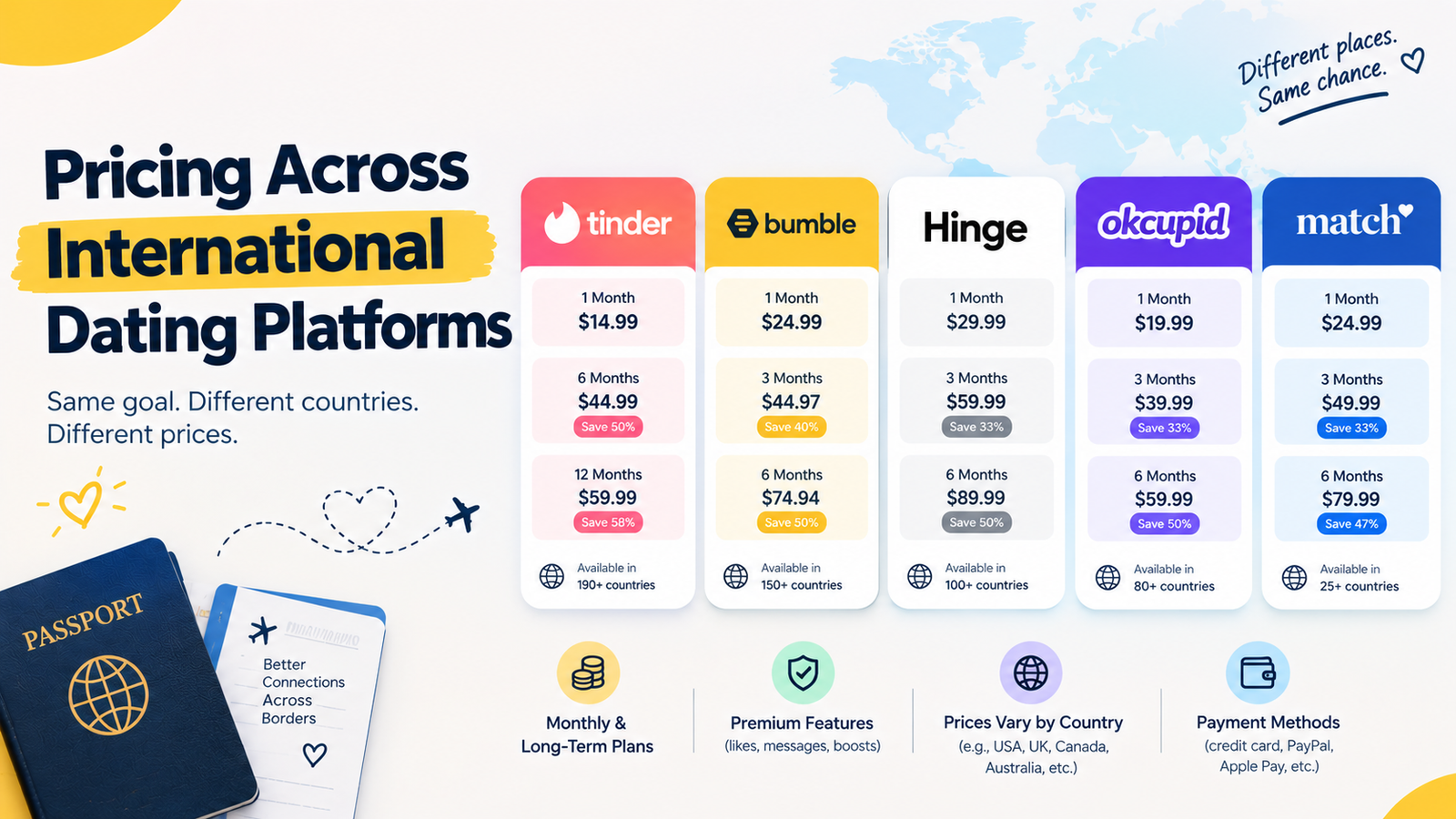
Pricing Across International Dating Platforms
| Platform Type | Model | Reported Range | Verification Note |
|---|---|---|---|
| Tinder (Passport, via Plus/Gold/Platinum) | Flat subscription | ~$25–$50+/month, reported to vary by age and region | Tinder’s own subscription page confirms Passports are bundled into paid tiers; the exact price is not published as a fixed figure. |
| Bumble (Premium, for international filtering/Travel Mode) | Flat subscription | Not independently verifiable to a single figure — see this research’s earlier finding that Bumble does not publish fixed pricing. | Confirmed directly from Bumble’s own support documentation |
| Match | Flat subscription | Reported roughly $20–$36/month, varies by term length | Third-party reviewer estimate, not an officially published rate card |
| InternationalCupid / Cupid Media network | Flat subscription (credit-based options on some sister sites) | Reported roughly $30–$50/month on standard plans | Third-party estimate; auto-renewal is a frequent complaint theme in reviews |
| AnastasiaDate-cluster sites (pay-per-letter model) | Pay-per-credit/message, historically | Reported to run into hundreds of dollars for active correspondence, per multiple user accounts | Not independently verified to a fixed rate; costs described by users as scaling with usage, which is itself a documented complaint pattern |
The clearest, most verifiable takeaway: none of these platforms publish one fixed, universal price, and every category here should be checked directly, in-app or on-site, before assuming a cost. The pay-per-message model in particular has no fixed ceiling — cost scales directly with how much a user corresponds, which several independent reviews describe as a structural incentive for a platform to keep conversations going rather than to help users find a real match quickly.
Free vs. Paid: What You Actually Get
| Capability | Free | Paid |
|---|---|---|
| Create a profile, browse | Yes, on virtually all platforms in this category | N/A |
| Message a match on mainstream apps (Tinder, Bumble, Hinge, OkCupid). | Yes, once matched | Paid tiers add visibility/filtering features, not the basic ability to message. |
| Change location internationally (Tinder Passport, Match worldwide search) | No, typically gated | Yes — this is usually a paid-tier feature specifically. |
| Message on dedicated international sites (Cupid Media network) | Very limited, usually browse-only | Required for meaningful messaging on most of these platforms |
| Message on pay-per-letter sites | Minimal | Pay-as-you-go, with no fixed monthly ceiling |
| Verification, blocking, reporting | Free across every mainstream platform checked | Free across every mainstream platform checked |
This is the section most competing “best international dating sites” content skips entirely, and it matters for anyone whose international dating is heading toward marriage or a shared household.
The International Marriage Broker Regulation Act (IMBRA), passed in 2005 as part of the Violence Against Women Act reauthorisation and in effect since March 2006, regulates for-profit “international marriage brokers”—a legal category that, per a USCIS implementation memo and multiple immigration-law summaries reviewed for this research, covers virtually any for-profit business whose main purpose is facilitating dating or matchmaking between U.S. citizens and foreign nationals. Its core provisions, confirmed across a USCIS memo, a nonprofit legal summary, and several immigration attorneys’ explanations:
- A U.S. citizen petitioning for a K-1 fiancé(e) visa (filed via Form I-129F) must disclose specified violent criminal convictions, even old or sealed ones.
- International marriage brokers must collect this background information and share it with the foreign national before contact information is exchanged.
- A U.S. citizen is limited to two approved K-1 petitions in their lifetime, with at least two years between filings — a provision specifically designed to flag serial petitioners, with waivers available in limited circumstances.
- At the visa interview, a U.S. consular officer is required to ask the foreign fiancé(e) directly whether a marriage broker was involved and whether it complied with IMBRA’s disclosure requirements.
The purpose, stated plainly across every official and legal source reviewed, is protective: shielding foreign nationals—who are often unfamiliar with U.S. systems and in a position of real vulnerability—from entering a relationship with a U.S. citizen who has an undisclosed history of violence. IMBRA is a disclosure law, not a ban, and it does not apply to relationships that begin on mainstream dating apps without a commercial matchmaking business acting as an intermediary — though the practical reality is that a same-model dedicated international dating site could plausibly qualify as an “international marriage broker” under the law’s broad definition, a nuance almost no competing dating-content article mentions.
A companion note on the K-1 visa process itself, drawn from an immigration-services source reviewed in this research: petitioners and beneficiaries are generally expected to have met in person within the two years before filing, with waivers of this requirement described as rare and slow. This article is not a substitute for advice from an immigration attorney — the rules have specific edge cases and change — but knowing IMBRA exists, and roughly what it requires, is genuinely useful context before a cross-border relationship goes further.
Safety and Scams in International Dating
Romance scams are not unique to international dating, but distance is one of the primary tools scammers use, which makes this category a heightened-risk one specifically.
Federal Trade Commission data reviewed in earlier research this session found that nearly 60% of 2025 romance scam losses started on social media rather than dating apps or sites, and that scammers commonly build a false narrative involving overseas distance — a military deployment, an offshore work contract, an international business trip — specifically because it provides a built-in excuse to avoid meeting or even video calling. The same FTC reporting found that older adults report fraud at a lower rate than younger adults but lose more per incident, since scammers target available assets rather than gullibility.
Specific to international dating, the patterns documented across FTC guidance and the review-platform research above converge on the same red flags:
- Avoids live video calls or agrees, but the call never quite happens
- Professes strong feelings unusually fast, often within days
- Introduces a financial need — a medical emergency, a stuck shipment, a visa or travel fee — usually after weeks of relationship-building
- Asks to move communication off the platform quickly, to text or use a messaging app with no moderation
- Photos that reverse-image-search to someone else, though AI-generated images increasingly defeat this check
- On dedicated correspondence-model sites specifically: responses that feel scripted, arrive at all hours regardless of the other person’s stated time zone, or consistently deflect specific, personal follow-up questions
Practical protection steps, consistent across FTC guidance and this research: do a live video call — ideally one where you ask the other person to do something spontaneous, since scripted or deepfaked video struggles with the unexpected — before any emotional or financial commitment; never send money, cryptocurrency, or gift cards to someone you haven’t met in person, regardless of the story; keep early conversation on the platform rather than moving to an unmoderated app; and tell a friend or family member what’s going on, since isolation is a tool scammers rely on as much as distance is.
Cultural and Practical Considerations
Beyond scams, international dating carries ordinary logistical friction worth planning for honestly: time zone gaps that make spontaneous conversation difficult and often push a relationship toward scheduled video calls rather than casual texting; language barriers, which translation tools ease but don’t eliminate, particularly for nuance and humour; and the cost and logistics of meeting in person, which is both a safety recommendation and simply a practical requirement most people want before committing further. Couples who’ve built a relationship primarily through messaging and video calls commonly describe an adjustment period once they’re in the same room for the first time — the in-person dynamic doesn’t always match the version built through a screen, which is worth expecting rather than being surprised by.
Reviews across platforms in this category — reviewed here for recurring patterns, not treated as universally representative, since review platforms skew toward dissatisfied users — cluster around a few consistent themes: fake or scam profiles, mentioned across every platform type in this research, mainstream and dedicated alike, though at very different rates; billing and cancellation friction, a leading complaint specifically on the dedicated international sites; inconsistent moderation response, where users describe reporting suspected scam profiles and seeing no visible action; and, specific to the pay-per-message model, cost that scales unpredictably with how long a correspondence continues.
| Pros | Cons |
|---|---|
| Mainstream apps (Tinder, Bumble, Hinge, Match, and OkCupid) apply the same verification and moderation to international matches as local ones. | Distance is a tool scammers specifically rely on — FTC data shows this is a real, heightened risk factor. |
| Tinder Passport and similar features are inexpensive relative to dedicated international sites and bundle into tools people may already use. | No dedicated international dating platform in this research achieved a strong independent review score. |
| IMBRA provides real legal protections and disclosure requirements once a relationship moves toward a K-1 visa. | The pay-per-message business model used by some dedicated sites has a documented, independently corroborated pattern of alleged staff impersonation. |
| Video calling and translation tools make meaningful cross-cultural connections more accessible than ever. | Language and cultural gaps, plus time zone logistics, add real friction mainstream local dating doesn’t have. |
| A genuine, well-documented legal path (K-1 visa) exists for relationships that become serious. | The Cupid Media network carries very poor (1.2–1.9/5) independent review scores despite ranking well in search results |
| Platform | Type | Verification | Review Signal | Best For |
|---|---|---|---|---|
| Tinder (Passport) | Mainstream app, location add-on | Photo verification | Solid App Store/Play Store ratings (checked earlier this session) | Casual cross-border matching, travel, relocation |
| Bumble | Mainstream app, international by default | Photo + optional ID verification, documented anti-fraud tooling | 4.2–4.3/5 on official app stores (checked earlier this session) | Women-first structure, safety-documentation depth |
| Match | Mainstream site/app, worldwide search option | Standard profile verification | Established, long-running brand | Older, commitment-focused daters |
| Cupid Media network (InternationalCupid, etc.) | Dedicated international site | Limited, per review complaints | Poor — roughly 1.2–1.9/5 across multiple independent platforms | Not recommended without significant caution |
| AnastasiaDate-cluster sites | Dedicated, pay-per-message model | Unverified by this research | Multiple independent accounts alleging staff-run correspondence | Not recommended by this research |
This table reflects documented differences, not a declared universal winner — but where the evidence this research gathered points clearly toward caution on specific platforms, that’s stated directly rather than smoothed over.
- Start with a mainstream app if you’re new to this. The verification, moderation, and safety infrastructure are the same whether a match is local or international, and the cost (a standard subscription) is transparent relative to pay-per-message models.
- Treat any platform requesting payment per message as a red flag on the business model itself, independent of whether any individual person on it is genuine.
- If a relationship is heading toward marriage or immigration, involve an immigration attorney early, not after a petition is already filed — IMBRA’s rules have real edge cases.
- Video call before any financial or deep emotional commitment, on every platform type, no exceptions.
- Weight independent review data (Trustpilot, not the platform’s own testimonials) heavily when evaluating a dedicated international site — the gap between marketing copy and independent review scores was the single largest finding of this research.
Based on the evidence gathered here, international dating conducted through mainstream apps, with the same scepticism and safety practices any online dating requires, is a legitimate and increasingly common way relationships form — nothing in this research suggests otherwise. The picture is meaningfully more cautionary for the dedicated international dating site segment specifically, where independent review data and multiple firsthand accounts point to real, documented problems that a reader deserves to know about before paying and that several currently-ranking competitor articles do not disclose.
Whether international dating is “worth it” for a given reader depends on what they’re looking for and how much friction (cost, distance, legal complexity) they’re prepared to navigate — this article can document the trade-offs and the real risk patterns; it can’t make that call for an individual reader.


Frequently Asked Questions
Dating someone in a different country from your own, either through a mainstream dating app’s location features or through a platform built specifically for cross-border matchmaking.
It carries a meaningfully higher scam risk than local dating, because distance itself is a tool scammers rely on — FTC data shows scammers frequently build stories around overseas distance specifically because it excuses avoiding video calls or in-person meetings. Mainstream apps apply the same safety infrastructure to international matches as local ones; the dedicated international site segment carries additional, platform-specific concerns documented in this article.
Among mainstream apps, Tinder (via Passport), Bumble, Match, Hinge, and OkCupid all support international matching with standard verification and moderation. Among dedicated international sites, this research did not find one it could recommend without significant caveats — independent review data across the category was consistently poor.
The International Marriage Broker Regulation Act, a 2005 U.S. law requiring background-check disclosure when a U.S. citizen pursues a K-1 fiancé(e) visa, particularly when a commercial international marriage broker was involved. It’s designed to protect foreign nationals from undisclosed histories of violence in a U.S. sponsor.
Only if you’re a U.S. citizen planning to bring a foreign fiancé(e) to the U.S. to marry. It’s one legal path among several (a foreign spousal visa is another), and involves its own requirements, including that the couple has generally met in person within the prior two years.
Romance scams that use overseas distance as an excuse to avoid video calls, requests for money framed as emergencies after weeks of relationship-building, and — specific to some dedicated platforms — allegations of paid staff conducting correspondence rather than the person pictured.
nternationalCupid and the broader Cupid Media network carry very poor independent review scores (roughly 1.2–1.9 out of 5) with consistent fake-profile and billing complaints. AnastasiaDate and similarly-modeled/branded sites (AsianDate, AmoLatina, Dream Singles, JollyRomance, EuroCupid) carry multiple independent, detailed user accounts alleging paid staff simulate correspondence. This research recommends applying significant caution to both clusters.
Yes — both support location-based international matching (Tinder via the paid Passport feature; Bumble through general international availability), with the same verification and safety tools applied as local matches.
Translation apps used alongside a dating platform are the most common practical solution; several sources note this eases but doesn’t eliminate the loss of nuance and humor across languages.
Yes — IMBRA regulates rather than bans international marriage brokers, requiring them to collect and disclose background information rather than prohibiting the business model.
Complete a live video call first, ideally with an unscripted request during the call; tell someone you trust your plans; and treat any pressure to send money before meeting as a serious red flag, regardless of the explanation offered.
This research did not find independently verified, platform-agnostic success-rate statistics for international dating specifically, and treats platform-published “success story” claims as marketing rather than verified data — a distinction most competing content does not make.