
Casual Dating: What It Actually Means (and How to Do It Well)
Casual dating means spending romantic time with someone — dates, texting, sometimes intimacy — without the expectation that it becomes exclusive, long-term, or officially labelled. That’s the short version. The longer, more honest version is that almost nobody defines “casual” the same way, and most of the frustration people run into isn’t the dating part — it’s the mismatch between what each person privately assumes casual means.
This guide covers what actually separates casual dating from hookups, FWB, and situationships; what the etiquette looks like in practice; which apps are built for it; and what the data says about who’s actually doing it in 2026.
What Casual Dating Actually Means
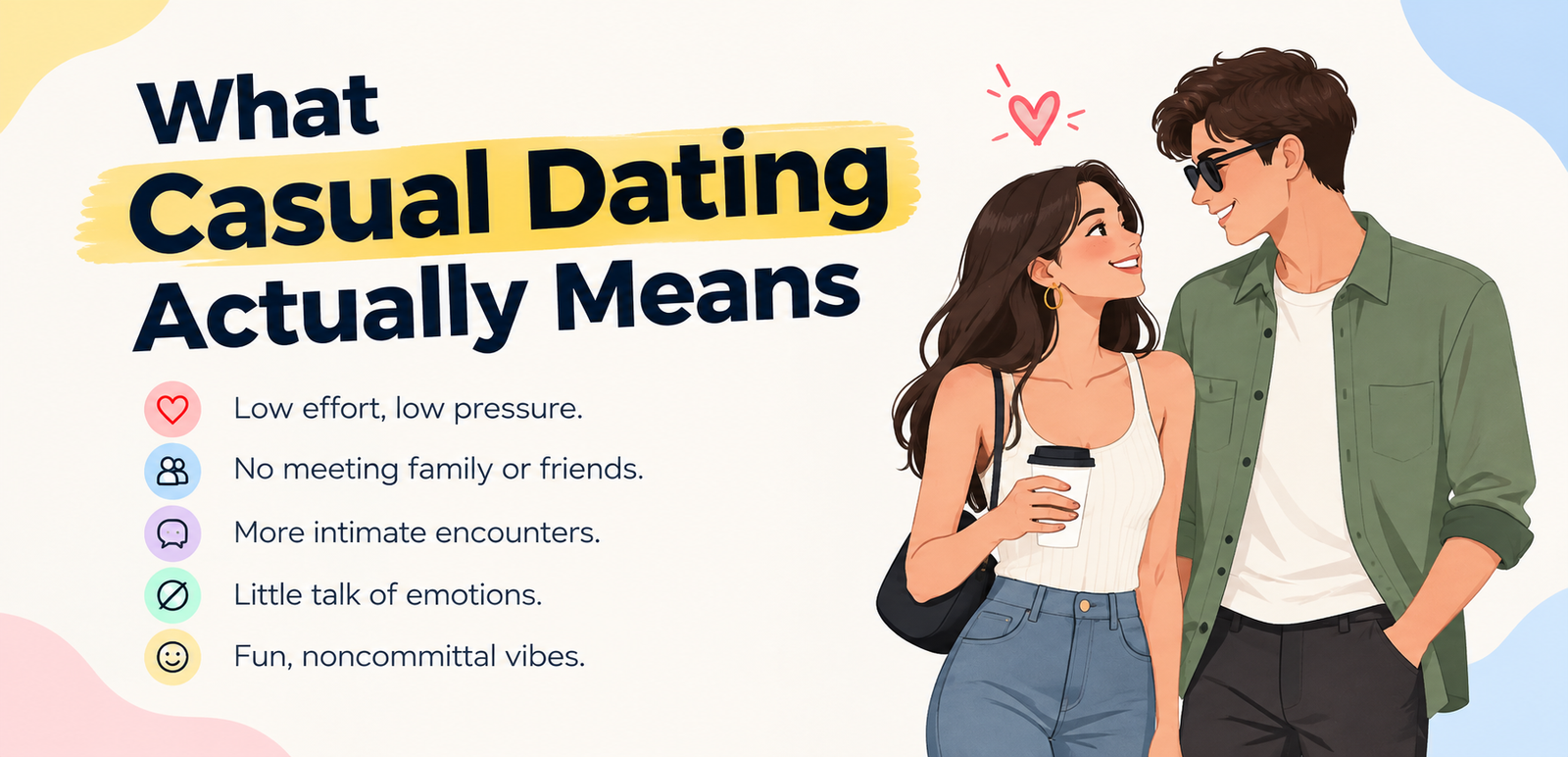
Casual dating is going on real dates — dinner, drinks, a walk, whatever — with someone, while keeping the relationship open-ended rather than working toward exclusivity or a defined future. It’s a recognised term with academic attention behind it, not just dating-app marketing: researchers studying college-age relationships have documented a range of reasons people pursue casual arrangements, from genuinely preferring non-exclusivity to using it as a lower-stakes way to date at all.
A few things casual dating is not, despite common conflation:
- It’s not automatically about sex. Healthline’s clinically reviewed guide to casual dating is direct about this: people who are casually dating typically call them “dates,” not hangouts, make actual plans, and spend time together that isn’t sexual — intimacy might be part of it, but it isn’t the definition.
- It’s not the same as polyamory. Casually dating multiple people isn’t automatically an ethically non-monogamous practice. Polyamory specifically involves consensual, often disclosed, multiple relationships; casual dating is usually just undefined, not structured around multiple committed partnerships.
- It’s not “no rules”. It has fewer rules than an exclusive relationship, but not none.
Best dating apps 2026
- September 13, 2026
Tinder Bio for Men: Best Examples, Ideas & Tips (2026)

- July 24, 2026
Tinder

- September 20, 2026
Senior Dating in 2026: Best Sites, Real Costs & Safety

- August 13, 2026
OkCupid
- September 27, 2026
International Dating in 2026: Platforms, Safety, Scams, and the Law
- October 3, 2026
Casual Dating: Rules, Etiquette & Best Apps for 2026
Casual Dating vs. Hookups, FWB, Situationships, and Relationships
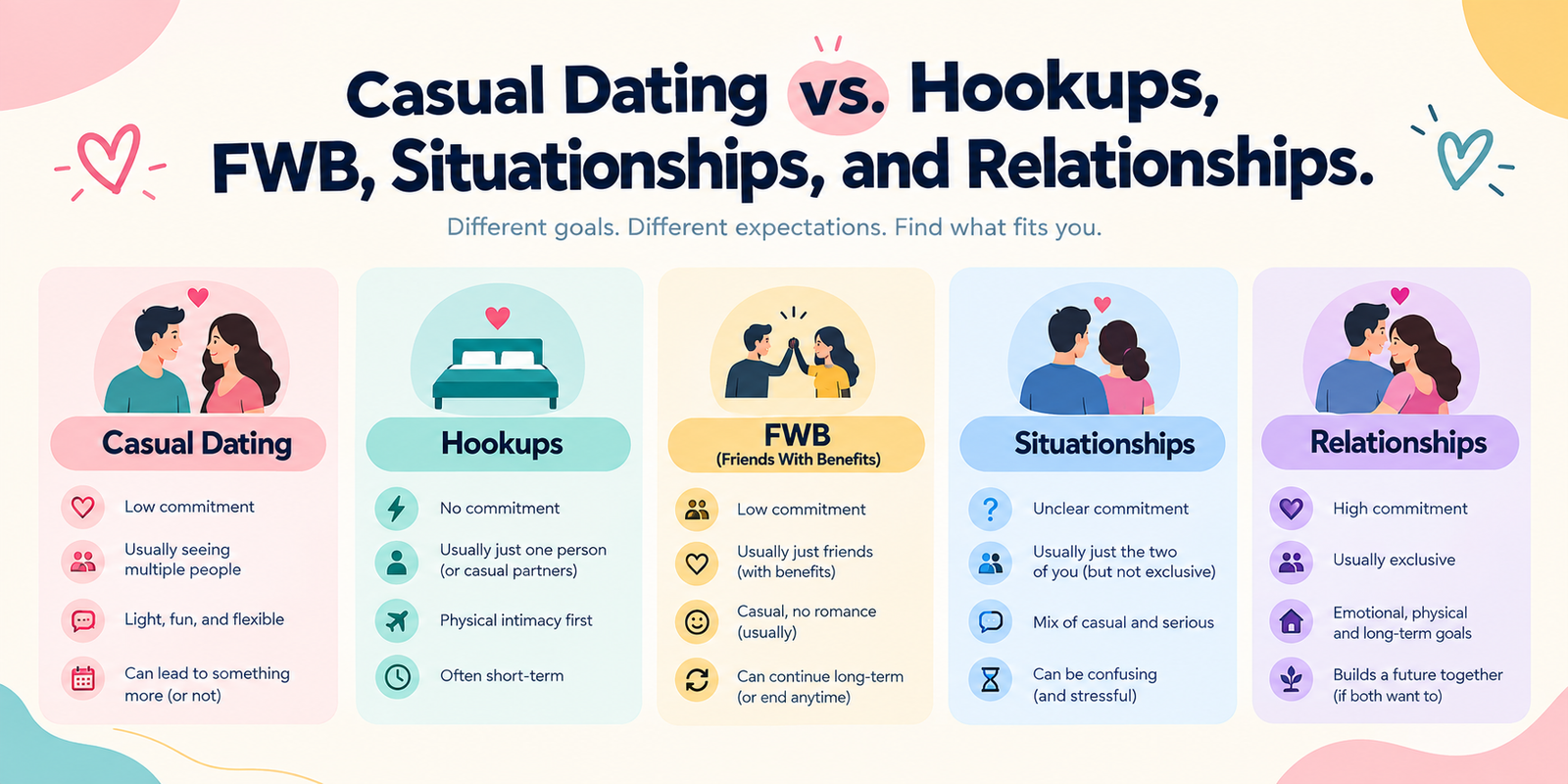
| Casual Dating | Hookup | Friends With Benefits | Situationship | Serious Relationship | |
|---|---|---|---|---|---|
| Actual dates? | Usually yes. | No | Sometimes | Often, but undefined | Yes. |
| Expectation of exclusivity | No, unless discussed | No | No | Unclear by design | Yes. |
| Emotional attachment | Some, openly acknowledged | Minimal | Varies, often downplayed | Present but unlabelled | Central |
| Primary purpose | Connection without commitment | Physical, one-off | Physical, recurring, between friends | Ambiguous — neither side has named it | Long-term partnership |
| Communication about what it is | Should be explicit | Rarely discussed | Sometimes discussed | Usually avoided | Explicit |
The clearest practical difference between casual dating and a situationship isn’t the behaviour — it’s the honesty. Casual dating works when both people know and have said out loud that it’s casual. A situationship is what happens when nobody’s said anything and both people are quietly operating on different assumptions.
How Common Is Casual Dating, Really?
The data paints a more complicated picture than “everyone’s casually dating now.”
Pew Research Center’s online dating research found that among people who use dating apps, roughly 44% are primarily looking for a serious relationship, while about 24% say they’re mainly there for something casual — the rest fall somewhere in between or aren’t sure. So casual intent is real and common, but it’s a minority use case even among app users, not the default.
Zoom out further and dating itself — casual or otherwise — is less universal than dating-app marketing suggests. The Institute for Family Studies’ 2026 State of Our Unions report, based on a nationally representative 2025 survey of over 5,000 unmarried adults aged 22–35, found that only about 30% of respondents were dating at all at the time of the survey, whether casually or exclusively. A separate Pew finding puts the share of single Gen Z adults (18–29) not actively looking for a relationship or casual dates at 57% — the highest rate on record.
Where casual dating is happening, attitudes are shifting in a specific direction: the Kinsey Institute’s 2026 The Singles in America survey (its 15th annual edition, surveying roughly 5,000 U.S. adults) found singles are more willing to give a second date a chance even when the first wasn’t exciting — 41% in 2026, up from 35% in 2021 — suggesting a bit less snap-judgement pickiness than dating-app culture is usually credited with, casual or not.
The honest summary: casual dating is a real, well-established minority preference among daters, not evidence that an entire generation has abandoned commitment. The people doing it tend to be a specific, self-selected group, not “everyone under 35.”
The Rules That Actually Matter
Every piece of credible advice on this converges on the same handful of points, so here’s the condensed version rather than padding it into twenty rules:
Say what you mean, early. Not on date one necessarily, but before things get emotionally complicated. “I’m looking to keep things casual right now” is a complete sentence. If the other person is hoping for more, they deserve the chance to decide that for themselves rather than finding out later.
Assume non-exclusivity until you’ve explicitly discussed otherwise. This cuts both ways — you’re not obligated to ask permission to see other people, but you’re also not entitled to assume someone else isn’t. If exclusivity matters to you, that’s a conversation, not an assumption.
Don’t ghost. Healthline’s guide is blunt about this one: casual doesn’t mean insignificant, and disappearing without a word causes real stress and confusion for the other person, however low-stakes the relationship was from your side. A short, honest message takes less effort than the guilt of avoiding one.
Keep the plans you make. It’s common to feel tempted to cancel for something that feels more exciting, but repeatedly deprioritising someone because something “better” came up is a fast way to make casuals feel disrespectful rather than just low-commitment.
Revisit the conversation if things change. What felt casual in week one might not in week six for one or both people. Checking in isn’t needy — it’s the thing that actually keeps casual dating from quietly turning into the exact mismatched-expectations situation it’s supposed to avoid.
Most mainstream dating apps can technically support casual dating, but some make it meaningfully easier to signal that intent clearly and find people looking for the same thing.
- Tinder remains the default starting point — its scale means the largest pool of people specifically browsing with casual intent, and its interface doesn’t push users toward relationship-orientated prompts the way some competitors do.
- Bumble works for casual dating within its existing structure (women message first in male-female matches within 24 hours), and its documented safety and verification tools — covered in depth elsewhere, based on Bumble’s own published support materials — carry over regardless of what someone’s looking for.
- OkCupid sits in a useful middle ground: its compatibility questions let users state casual intent explicitly as a filter rather than leaving it to guesswork while still supporting people looking for something more serious.
- Feeld is built specifically around open-mindedness — non-traditional structures, non-monogamy-adjacent dating, and explicit upfront labelling of what someone’s looking for — making it a stronger fit than mainstream apps for casual daters who want to avoid ambiguity entirely.
- Hinge is worth a specific caveat: it’s explicitly designed around prompts and relationship-building, and most of its user base says they’re looking for something serious. It’s not off-limits for casual dating, but it’s the weakest fit on this list for that specific intent.
- Grindr and HER serve casual dating within LGBTQ+ communities specifically, with location-based discovery that’s historically been more geared toward immediacy than the prompt-heavy formats some newer apps use.
A practical note: stating your intent clearly in your profile — “not looking for anything serious right now” or similar — does more to find compatible matches than app choice alone. Every app above supports casual dating; none of them can fix an ambiguous profile.
Pros and Cons of Casual Dating
| Pros | Cons |
|---|---|
| Lower pressure than dating with a defined relationship goal | Easy for expectations to drift apart if communication lapses. |
| A genuine way to learn your own preferences before committing to anyone | Can be used to avoid vulnerability rather than as an honest preference — worth being self-aware about which one is true for you |
| Flexibility to date multiple people or focus on other parts of life | Requires more deliberate communication, not less, to stay healthy. |
| Useful transitional step for people easing back into dating after a breakup or difficult relationship history | Not well-suited to people who develop strong attachment quickly, regardless of intention |
| Doesn’t require sex to be part of it, despite common assumptions | Social and family pressure can make sustained casual dating feel harder to explain or justify than it should. |
Who Casual Dating Is (and Isn't) Right For
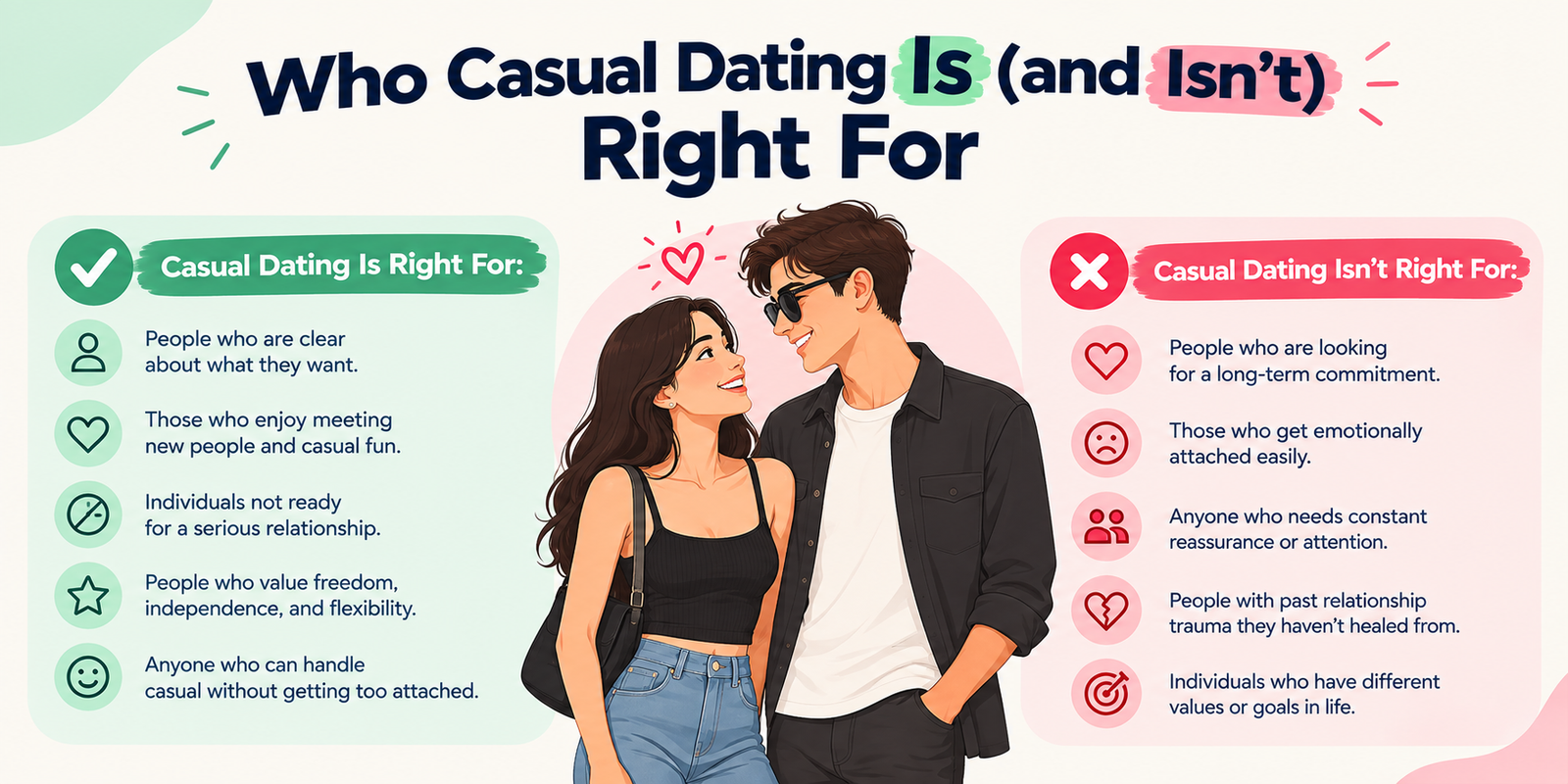
Casual dating tends to work well for people who are rebuilding confidence after a breakup, prioritising other parts of life (career, personal growth, moving cities) over relationship-building right now, or who’ve realised through experience that they genuinely prefer open-ended connection over defined relationships. It tends to work poorly for people who reliably develop strong romantic attachment regardless of intention, who need a relationship label to feel secure, or who are using it specifically to avoid the vulnerability a serious relationship would require — not because that’s dishonest, but because it tends to produce more hurt than the “casual” framing is built to handle.
Healthline’s guidance on this is useful: if casual dating consistently feels bad rather than freeing, that’s a sufficient reason to stop, independent of whether you can articulate exactly why.
The physical-safety basics are the same ones that apply to dating generally: meet in public first, tell someone where you’re going, and trust your own discomfort over social pressure to be polite.
Two things specific to casual dating are worth naming directly. First, if sex is part of the arrangement, using barrier methods consistently and getting tested for STIs regularly isn’t optional just because the relationship is casual — Healthline’s clinical guidance is explicit that sexual health precautions matter exactly as much in casual dating as anywhere else. Second, emotional safety takes active maintenance here in a way it doesn’t always in a defined relationship: because the structure is inherently less certain, it’s worth periodically checking in with yourself about whether you’re still comfortable with the ambiguity, rather than assuming your feelings haven’t shifted since the arrangement started.
It happens, and it doesn’t mean you did casual dating “wrong”. The healthiest response, per Healthline’s guidance, is telling the other person directly rather than sitting on it — both because they might feel the same way and because staying quiet tends to cause more hurt over time than finding out where you actually stand. If they don’t feel the same, that’s a legitimate, survivable outcome, not a sign the whole approach failed.



Frequently Asked Questions
Spending romantic time with someone — dates, texting, sometimes physical intimacy — without an expectation of exclusivity, a relationship label, or a long-term plan together.
No. Hookups are typically a single physical encounter with no ongoing structure. Casual dating usually involves repeated dates, regular contact, and some acknowledged emotional connection, even without commitment.
Mainly honesty. Casual dating is explicitly discussed and agreed upon by both people. A situationship is what happens when neither person has defined the relationship, often leaving both people guessing.
Yes, regularly — but it requires an explicit conversation to actually change the terms, not just an assumption that feelings evolving on their own will update the arrangement.
No. Physical intimacy is common in casual dating but not a requirement — it’s entirely possible to date casually and keep things non-sexual, as long as both people are clear about that boundary.
The core ones: be upfront about wanting something casual, don’t assume exclusivity without discussing it, don’t ghost, keep the plans you make, and revisit the conversation if your feelings change.
Tinder and Feeld are generally the clearest fits for explicitly casual intent; Bumble and OkCupid support it well within broader platforms; Hinge is the weakest match since it’s built around relationship-orientated prompts.
It can be, for people who genuinely prefer it and communicate clearly. It tends to work less well for people using it to avoid vulnerability, or who develop strong attachment regardless of intention — in which case the “casual” framing usually causes more hurt than it prevents.
Among dating app users specifically, roughly a quarter say they’re primarily there for something casual, per Pew Research — a real and established minority, not the default majority some dating-culture commentary suggests.