
- Home
- >
- Blogs
- >
- Tips & Guide
- >
- Senior Dating in

Senior Dating in 2026: What Actually Works After 50
If you’re thinking about dating again after 50, here’s the honest version: online dating works for plenty of older adults, but the experience is genuinely different from what younger people encounter — and different from what most “best senior dating sites” lists suggest.
The quick answer: Match has by far the deepest pool of over-50 daters. OurTime and SilverSingles narrow the pool to your age group but charge for it; eharmony suits people who want an algorithm to do the searching, and Facebook Dating is the most-used free option among older adults despite rarely appearing in roundups. Roughly half of over-50 daters pay for nothing at all.
The bigger thing to know before you start: the most useful data on senior dating comes from Pew Research Center and the FTC, not from review sites. And what it shows is more encouraging in some ways — and more sobering in others — than the usual advice.
Senior Dating by the Numbers
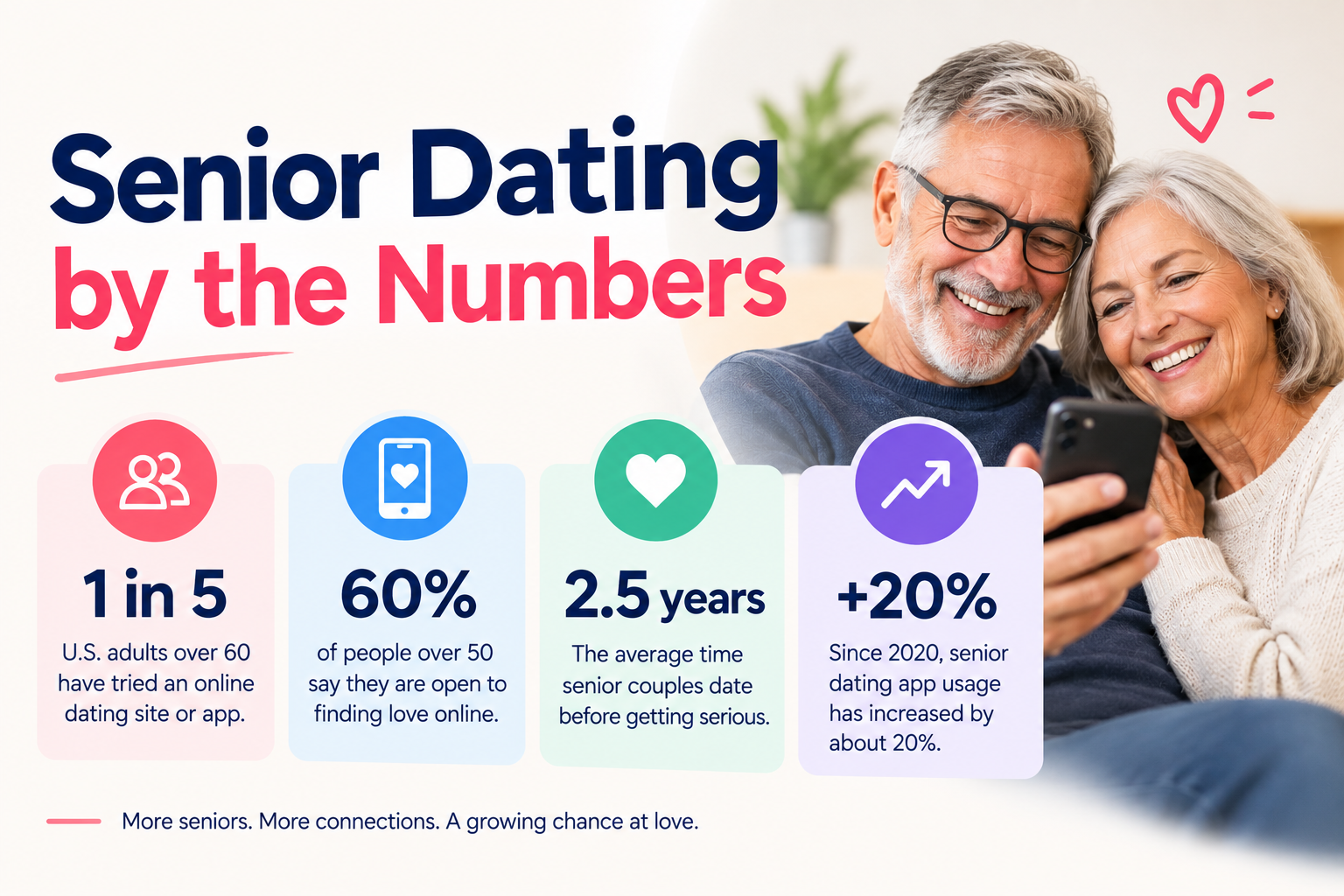
Pew Research Center’s most recent dedicated study of older online daters surveyed 6,034 U.S. adults in July 2022 and was published in July 2023. It remains the most rigorous public data on this specific question. Here’s what it found.
| Finding | Adults 50+ |
|---|---|
| Have ever used a dating site or app | 17% |
| …in their 50s | 23% |
| …in their 60s | 14% |
| …in their 70s and older | 12% |
| Currently using, or used in the past year | 3% |
| Partnered adults who met their partner online | 6% |
| Encountered someone they thought was a scammer | 47% |
Source: Pew Research Center, survey conducted July 5–17, 2022.
One in six Americans ages 50 and older (17%) say they have ever used a dating site or app — similar to the share who said the same in 2019. So the category hasn’t exploded among older adults the way it has for younger ones. It’s been roughly flat.
The drop-off nobody mentions
Here’s the number that reframes everything, and it’s one most roundups skip: just 3% of adults 50 and older currently use online dating platforms or have used them within the last year, compared with 15% of those under 50.
Sit with the gap. Seventeen per cent have tried it. Three per cent are still doing it. That’s a retention collapse, not an awareness problem — the overwhelming majority of older adults who sign up don’t stick around.
That matters for you in a practical way. It means the “huge user base” a site advertises includes a lot of dormant accounts, and it means if you join and feel like it isn’t working after a month, you are experiencing the norm, not a personal failure.
Which platforms older daters actually use
Age changes platform choice dramatically. Online dating users 50 and older are far less likely than those under 50 to have used Tinder (11% vs. 59%) and more likely to have used Match (50% vs. 24%).
The Tinder cliff inside the 50+ group is steeper still: 19% of online daters ages 50 to 59 say they’ve used Tinder, compared with 6% of those 60 to 69 and just 1% of those 70 and older.
The takeaway is simple. If you’re in your early 50s, mainstream apps are still a live option. Past 65, they largely aren’t — not because you can’t use them, but because your peers aren’t there.
Men and women are having different experiences.
This is the finding I’d most want a friend over 50 to know before signing up, and it’s almost entirely absent from competing guides.
Women 50 and older who have used online dating platforms are more likely than men in the same age group to say their experiences have been negative (57% vs. 38%). That’s a 19-point gap. Among users aged 18 to 49, the same gender gap is small (48% vs. 43%).
So the negative-experience gap between men and women widens substantially with age. And the money flows the other way: men ages 50 to 64 are 13 percentage points more likely than women the same age to have paid for online dating, and men 65 and older are 22 points more likely.
Men over 50 pay more and report better experiences. Women over 50 pay less and report worse ones. Any advice that treats “senior dating” as one uniform experience is missing half the picture.
Best dating apps 2026

- September 13, 2026
Tinder Bio for Men: Best Examples, Ideas & Tips (2026)

- July 24, 2026
Tinder

- September 20, 2026
Senior Dating in 2026: Best Sites, Real Costs & Safety

- August 13, 2026
OkCupid
- August 15, 2026
Best Dating Apps of 2026: 7 Picks Worth Your Time and Money
- August 19, 2026
6 Best Dating Apps of 2026
Senior Dating Sites Compared
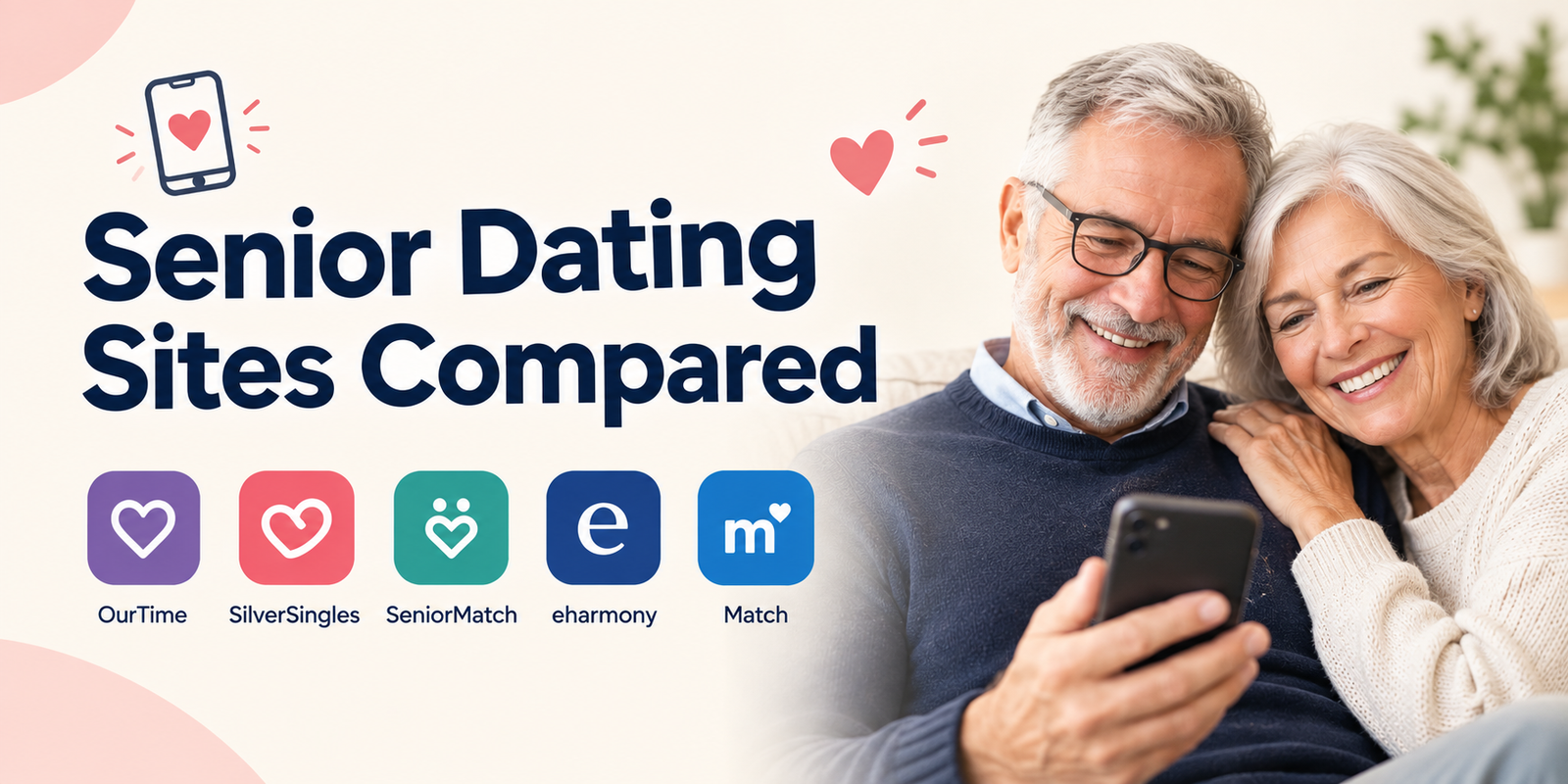
| Platform | Who it’s for | Free tier | What to know |
|---|---|---|---|
| Match | Over-50 daters wanting the biggest pool | Browse only | Most-used platform among 50+ online daters (50%). No one-month plan. |
| OurTime | 50+ daters wanting an age-specific site | Preview only | Owned by Match Group. Reviewers report roughly $13–$35/month depending on term. |
| SilverSingles | 50+ daters who want curated daily matches | Stronger than most | Personality test-based. Pricing varies enormously (see below). |
| eharmony | Marriage-minded daters who want matching done for them | Limited | No one-month plan. Compatibility-questionnaire driven. |
| SeniorMatch | 50+ daters wanting a smaller, focused community | Limited | AARP found a one-month plan at $29.95 — cheaper than SilverSingles’ one-month. |
| Facebook Dating | Budget-conscious daters already on Facebook | Fully free | Most-used free platform among 50+ daters per AARP, yet rarely recommended. |
Note on the table: platform pricing and features change constantly and vary by region and promotion. Treat these as orientation, not quotes, and confirm at checkout.
The Free vs. Paid Question
Here’s where I’d push back on most of the senior dating advice you’ll find.
AARP surveyed 300 adults aged 50 and older and found that nearly half (48 per cent) exclusively use free dating sites, with the most commonly used free platform being Facebook Dating, followed by the free versions of Plenty of Fish and Tinder. The same survey found around half (49 per cent) had used a dating site within the past three years.
That’s a small sample — 300 people — so treat the precise percentages loosely. But the direction is worth sitting with, because nearly every “best senior dating sites” article ranks paid subscription platforms almost exclusively, and Facebook Dating rarely appears at all.
There’s a structural reason. Paid dating sites run affiliate programmes that pay publishers commissions per signup. Facebook Dating doesn’t. When roughly half of your audience uses free platforms and the most popular free platform is systematically missing from the recommendations, that’s worth knowing about the genre you’re reading.
None of which means paid sites are a rip-off. Paywalls filter for intent — someone who paid for six months is likelier to reply than someone who downloaded a free app out of boredom. About half of adults 50 and older who dated online in the past year cite meeting a long-term partner or spouse as a major reason, and if that’s you, a paywall is a feature.
The honest framing: pay if the cost is comfortable and you want a filtered pool. Don’t pay because an article implied free options don’t exist.
What Senior Dating Sites Actually Cost
Pricing here is genuinely hard to pin down, and I want to be straight about why rather than give you a confident number that’s wrong.
Checking SilverSingles’ monthly cost across reputable review sites returns figures ranging from about $13.95 to $57.95 per month. Not because reviewers are careless — because these platforms run heavy promotional and dynamic pricing. The same plan is quoted differently depending on when someone checked, from where, and what promotion was live.
A few anchors I can report with reasonable confidence, from AARP’s hands-on review updated in April 2026:
- SilverSingles’ one-month subscription was $54.99
- SeniorMatch offered a one-month subscription for $29.95
- eharmony and Match don’t offer one-month plans at all
Three practical rules follow:
- Never judge a platform by its one-month price. Long-term plans routinely cost half to a third as much per month — but they’re billed as a lump sum upfront.
- Check the total, not the monthly rate. A “$13.95/month” plan is often a single charge for six months.
- Shop it like airfare. Check in a private browsing window, and check again a day later. Given how widely quoted prices vary, the first number you see is rarely the only one available.
And check the auto-renewal terms before you pay. Subscription cancellation complaints are among the most common grievances across every platform in this category.
This is where I’d most urge you to ignore conventional wisdom, because the standard senior dating safety advice points at the wrong threat.
The scam usually doesn’t start on a dating app.
The FTC’s April 2026 Data Spotlight found that nearly 60% of people who reported losing money to a romance scam in 2025 said it started on a social media platform. Not a dating app. Social media.
More broadly, in 2025, people reported losing more money to scams that started on Facebook than on any other social media platform, with WhatsApp and Instagram a distant second and third. Across all scam types, reported losses to social-media-originated scams reached $2.1 billion — about eight times the 2020 figure.
The pattern the FTC describes: scammers tailor their pitch based on people’s profiles, then later invent a crisis requiring money or casually offer investment advice to draw them onto a fake investment platform.
So the friend request from an attractive stranger on Facebook deserves more suspicion than a match on a paid dating site. Most senior dating safety advice has this backwards.
Older adults aren’t more gullible — they lose more per incident.
The FTC’s December 2025 report to Congress contains a finding that quietly demolishes a stereotype: older adults reported losing money to fraud at a lower rate than younger adults, which the FTC notes is consistent with previous years and may suggest older adults are more likely to avoid losing money when exposed to fraud or more inclined to report fraud when no loss occurred.
The problem isn’t frequency. It’s size. Total fraud losses reported by adults 60 and over rose roughly fourfold between 2020 and 2024, from about $600 million to $2.4 billion — an increase largely driven by reports of losses over $100,000, often to investment scams, romance scams, or impersonations. Older adults also report much higher median individual losses than younger adults.
The reason is straightforward and has nothing to do with judgement: a 65-year-old with retirement savings has more to lose than a 25-year-old. Scammers target assets, not naïveté.
Harassment and scam contact are common.
Pew found 47% of online daters 50 and older encountered someone they thought was trying to scam them, with those 50 to 64 more likely than those 65 and older to report this (52% vs. 39%).
On harassment, 45% of online daters 50 or older reported experiencing at least one of four unwanted behaviours: 33% were sent sexually explicit content they didn’t ask for, 26% had someone continue contacting them after they expressed disinterest, 17% were called an offensive name, and 4% were threatened with physical harm.
Worth noting, since it runs against expectation: these experiences are less common for users 65 and older than for younger users — half of users under 65 reported at least one, compared with one in three users 65 and older.
Practical safety rules
- Video call before meeting. Ask them to do something spontaneous on camera — wave, turn the phone around. Scripted deepfakes struggle with the unexpected.
- Never send money. No exceptions, no matter the emergency, and no matter how long you’ve been talking. The crisis is the scam.
- Never take investment advice from someone you met online. This is the single fastest-growing pattern in the FTC data.
- Keep conversation on the platform until you’ve met. Scammers push to move to text or WhatsApp early, where there’s no moderation.
- Reverse image search their photos — though be aware AI-generated images can defeat this.
- Tell someone. Give a friend or adult child the name, the plan, and the location for any first meeting.
- Meet in public, and arrange your own transport. Both ways.
If something has already gone wrong, report it at reportfraud. ftc.gov. The FTC notes most fraud goes unreported, largely out of embarrassment — and that under-reporting is exactly what lets these operations keep running.
Practical Advice for Dating Again After 50
Pick the platform where your peers actually are. For most people over 60, that means Match, OurTime, SilverSingles, or Facebook Dating — not Tinder or Hinge, where the over-65 population is close to nonexistent.
Expect a slower pace, and treat that as a feature. Older daters skew toward fewer, longer conversations. Someone taking two days to reply isn’t uninterested — they’re probably not treating their phone as a slot machine.
Be specific about what you want. Among older adults who dated online in the past year, about half cite finding a long-term partner or spouse as a major reason, 36% cite dating casually, 30% make friends, and 22% do casual sex. That’s a genuinely mixed pool. Saying plainly what you’re after saves months.
Use recent photos. This is the single most common complaint older daters make about each other. A photo from 2012 doesn’t help you — it guarantees an awkward first meeting.
Write a profile with hooks. Specifics give people something to reply to. “I’ve been trying to keep a lemon tree alive for three years” gets more responses than “I enjoy travel and laughing.”
Consider meeting people offline in parallel. Given the 3% retention figure, treating apps as one channel among several — volunteering, classes, community groups, faith organisations, walking clubs — is a realistic strategy rather than a consolation prize.
Alternatives to Senior Dating Sites
- Facebook Dating — free, built into an app many older adults already use, and the most-used free option in AARP’s survey.
- Activity-based groups — hiking clubs, choirs, pickleball leagues, volunteer organisations. Slower, but you see how someone behaves before deciding anything.
- Professional matchmakers — expensive, but some platforms, including SilverSingles, offer matchmaking tiers, and independent matchmakers exist in most cities. Worth considering if writing a profile is the obstacle.
- Speed dating and singles events for over-50s — check whether OurTime or local community organisations run events near you.
- Your existing network — telling friends you’re open to being set up remains genuinely effective and costs nothing.
Senior dating in 2026 is neither the disaster nor the renaissance it gets described as. The data shows a category that a lot of older adults try, most don’t stay in, and a meaningful minority succeed with.
What the numbers actually recommend: go where your age group is rather than where the marketing is loudest, treat any one-month price as the worst deal on offer, and aim your scam vigilance at unsolicited social media approaches rather than at the best free dating apps, because that’s where nearly 60% of the money is actually lost.
And if it doesn’t work quickly, the retention data says that’s the common experience, not a verdict on you. Most people who try this move on — which is a reasonable thing to do, especially if you’re also meeting people in the rest of your life.


Frequently Asked Questions
For some people, clearly. But set expectations from the data: 6% of partnered adults 50 and older say they met their significant other through online dating, and 53% of all online daters describe their experience as positive versus 46% negative. It works, but it isn’t a solved problem, and the retention numbers suggest most older adults try it and move on.
There isn’t one universal answer. Match has the largest over-50 population. OurTime and SilverSingles narrow the pool to your age group. eharmony suits people who want matching handled for them. Facebook Dating is the best free starting point. The right choice depends on your budget and whether you prefer searching yourself or being matched.
Yes, though most “free” platforms restrict messaging. Facebook Dating is fully free and the most-used free option among older adults per AARP’s survey. Most dedicated senior sites offer free profile creation but require payment to actually message anyone.
No platform is fully safe, and the FTC data suggests platform choice matters less than behavior. Nearly 60% of 2025 romance scam losses started on social media rather than dating apps, so vigilance about unsolicited approaches matters more than which site you pick.
Genuinely variable. AARP found SilverSingles’ one-month plan at $54.99 and SeniorMatch’s at $29.95, while eharmony and Match don’t offer one-month plans. Longer terms cut the monthly rate substantially but are billed upfront. Quoted prices differ widely between reviewers, so check the actual checkout screen.
Generally not, for demographic reasons rather than design ones. Tinder use falls to 6% among online daters aged 60 to 69 and 1% among those 70 and older. You can use them; you likely won’t find many peers.
Pew documents the gap clearly — 57% of women 50+ report negative experiences versus 38% of men — but survey data shows the pattern, not the cause. Harassment rates and differing goals within the same pool are plausible contributors, and it’s worth knowing the gap exists before judging your own experience against a friend’s.
The reliable signals: they avoid video calls or make excuses; they push to move off-platform quickly; their story involves distance (overseas work, military deployment, offshore contracts); and eventually there’s a crisis requiring money, or an investment opportunity. The FTC describes scammers tailoring their approach from your profile, then inventing a crisis or offering investment advice to move victims onto fake investment platforms. Anyone you’ve never met in person asking for money is a scammer — no exceptions.
That’s personal, but there’s a safety argument for telling at least one trusted person. The FTC notes that shame keeps much fraud unreported, and isolation is what scammers rely on. Someone who knows what’s happening is a practical safeguard.